Burpee Fitness Test Calculator
Quick Answer
This calculator scores your burpee fitness test performance using international standards validated by research on 9,833 participants. Get instant ratings for tests from 30 seconds to 5 minutes.
- Based on Podstawski et al. (2019) peer-reviewed research
- Calculates burpees per minute rate and percentile ranking
- Provides sport-specific training recommendations
What is the Burpee Fitness Test?
The burpee fitness test is a simple but challenging test of strength endurance, agility, balance and coordination. Participants attempt to complete the maximum number of burpees within a set time period, typically ranging from 30 seconds to 5 minutes. The burpee exercise is also known as the Squat Thrust & Jump, combining multiple movements into one demanding exercise that tests your whole-body fitness.
Test Purpose: This is primarily a test of strength endurance, though body control, balance, coordination, and anaerobic capacity are also significant factors. The burpee engages major muscle groups including the legs, core, chest, shoulders, and arms, making it an excellent assessment of overall functional fitness.
Equipment Required: Stopwatch or timer, non-slip surface, and adequate space for movement.
How to Perform the Burpee Test
Pre-test Preparation: Explain the test procedures to the subject. Perform screening of health risks and obtain informed consent. Prepare forms and record basic information such as age, height, body weight, gender, and test conditions. See more details of pre-test procedures.
Burpee Technique
The standard starting position for the burpee is standing erect with the arms by the side. From the standing position:
- Squat down and place the hands on the floor in front of the feet
- Putting the bodyweight on the hands, thrust the legs back to a push-up position with a straight line from the shoulders to the heels
- Pull the legs back and return to the squatting position
- Stand up to complete one burpee cycle
One complete burpee is from the standing position back to the standing position. In the Spartan SGX Fitness Test, a 5-minute burpee test is conducted. In their test protocol, at the 'bottom' of the burpee the chest must touch the ground, and at the 'finish' of the burpee, the feet must leave the ground with the hands reaching above the ears.
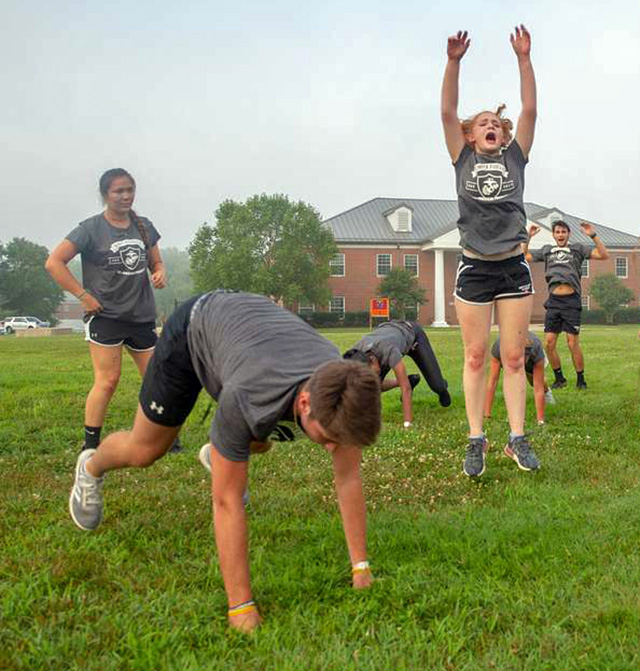
Burpee exercise fitness test demonstration
Test Procedure
The test requires the athlete to perform as many burpees as possible within the chosen time limit. Common test durations include:
- 30 seconds - Quick assessment of power and speed
- 1 minute - Standard short-duration test
- 3 minutes - International standard duration (most validated)
- 5 minutes - Extended endurance test (Spartan protocol)
Time how many correctly performed burpees are completed within the time limit and enter your score in the calculator above for instant feedback.
Burpee Test Scoring Standards
Performance standards vary by test duration and gender. The following norms are based on international research by Podstawski et al. (2019), which studied 9,833 participants aged 18-25 across four countries.
30-Second Burpee Test
A good result for a 30-second test is greater than 16 burpees for men and greater than 12 for women. This quick test primarily assesses anaerobic power and explosive strength.
3-Minute Burpee Test (International Standard)
The 3-minute burpee test is the most validated duration with established international norms:
- Men average: 56.69 burpees (range: 47-66 for average category)
- Women average: 48.84 burpees (range: 37-60 for average category)
- Best recorded male: 82 burpees in 3 minutes
- Best recorded female: 73 burpees in 3 minutes
5-Minute Spartan Fit Standard
To be considered Spartan Fit, adults need to complete over 80 burpees (women) or 85 burpees (men) in five minutes using proper Spartan form (chest to ground, feet leave ground with hands above ears).
Benefits of the Burpee Test
Advantages: This is a simple test to conduct, as no specialised equipment is required—just a watch or stopwatch. It can be conducted almost anywhere, and can be self-administered. The test provides a comprehensive assessment of multiple fitness components in a single exercise.
Fitness Components Assessed:
- Strength endurance (primary)
- Anaerobic capacity
- Coordination and agility
- Balance and body control
- Cardiovascular fitness
- Mental toughness
Sport-Specific Applications
The burpee test is used across various sports and fitness contexts:
CrossFit and Functional Fitness
Burpees are a staple of CrossFit workouts and competitions. Athletes use regular burpee testing to track conditioning improvements. Elite CrossFit competitors can often exceed 25 burpees per minute with proper pacing.
Military and Tactical Fitness
Many military organizations use burpee variations for fitness assessment and training. The Mountain Tactical Institute (MTI) developed the Burpee Beep Test, a progressive test adding 2 burpees per minute until failure.
Obstacle Course Racing
Spartan Race and other obstacle course events use burpees as a penalty for failed obstacles—typically 30 burpees per missed obstacle. The 5-minute burpee test is directly relevant to Spartan fitness preparation.
Team Sports Conditioning
Basketball, soccer, rugby, and other field sport athletes use burpee testing as part of pre-season fitness assessments. The test's combination of strength and cardio demands mirrors game requirements.
How to Improve Your Burpee Test Score
Improving your burpee performance requires a combination of strength, endurance, and technique work:
For Beginners
- Start with step-back burpees (no jumping)
- Use an elevated surface for hands to reduce difficulty
- Practice 2-3 sessions per week with adequate rest
- Build to 3 sets of 10 standard burpees before timing tests
For Intermediate Athletes
- Practice EMOM (Every Minute On the Minute) workouts: 10-15 burpees every minute for 10 minutes
- Incorporate strength work: squats, push-ups, box jumps
- Focus on efficient movement patterns to conserve energy
- Aim for 10-15% improvement over 4-6 weeks
For Advanced Athletes
- Add variations: burpee box jumps, burpee pull-ups, weighted burpees
- Train with Tabata intervals: 20 seconds max effort, 10 seconds rest, 8 rounds
- Practice race-pace burpees for target test duration
- Work on cardiovascular base with running or rowing
Frequently Asked Questions
What is a good burpee test score?
For the standard 3-minute test, scores above 67 burpees for men and 61 for women are considered "good." Average scores range from 47-66 for men and 37-60 for women based on international research. Use the calculator above for instant rating based on your specific test duration.
How accurate is the burpee test calculator?
The calculator uses validated standards from peer-reviewed research by Podstawski et al. (2019), which studied 9,833 participants across Poland, Great Britain, Hungary, and Serbia. The norms are specifically validated for adults aged 18-25, though they provide useful benchmarks for other age groups.
How many burpees can the average person do?
According to Strength Level data, the average male can do about 36 burpees and the average female about 29 burpees. For a timed 3-minute test, averages are 57 burpees for men and 49 for women.
How many calories do burpees burn?
Burpees burn approximately 8-12 calories per minute depending on body weight and intensity. A 70kg person completing 50 burpees in 3 minutes burns roughly 24-30 calories. The calculator provides an estimate based on your body weight.
What is the world record for burpees?
Various burpee records exist for different time frames. For the 3-minute test in research settings, the highest recorded was 82 burpees (male) and 73 burpees (female). Professional athletes and CrossFit competitors can often exceed these numbers.
Should I do the burpee test with or without a push-up?
Standard burpee tests typically do not require a push-up, though many protocols (including Spartan) require chest-to-ground contact. Be consistent with your technique when comparing scores over time. The calculator standards assume standard burpee form.
How often should I take the burpee test?
For tracking progress, test every 4-6 weeks. This allows adequate time for training adaptations while providing regular feedback. Avoid testing too frequently as the test is demanding and requires full recovery for accurate results.
References
- Podstawski, R., Markowski, P., Clark, C., Choszcz, D., Ihász, F., Stojiljković, S., & Gronek, P. (2019). "International Standards for the 3-Minute Burpee Test: High-Intensity Motor Performance." Journal of Human Kinetics, 69(1), 137-147.
- Podstawski, R., Kasietczuk, B., Boraczyński, T., Boraczyński, M., & Choszcz, D. (2013). "Relationship Between BMI and Endurance-Strength Abilities Assessed by the 3 Minute Burpee Test." International Journal of Sport Science, 3(1), 28-35.
- Burpee, R.H. (1940). "Seven Quickly Administered Tests of Physical Capacity." Ph.D. Thesis, Columbia University.
- Feito, Y., et al. (2018). "High-Intensity Functional Training (HIFT): Definition and Research Implications for Improved Fitness." Sports, 6(3), 76.
- Spartan Race. "SGX Fitness Test Protocol." spartan.com
Similar Tests
- Push-up test - Upper body strength endurance
- Ins & Outs Core Strength Test
Related Pages
 Any comments, suggestions, or corrections? Please let us know.