Balance Beam Test Calculator
Quick Answer
This calculator averages multiple judge scores across three trials to determine your balance beam test performance. The test assesses dynamic balance through the ability to walk an elevated beam steadily within six seconds.
- Calculates average scores from 1-5 judges per trial
- Based on validated 0-5 scoring protocol
- Used for gymnast screening and athletic balance assessment
What is the Balance Beam Test?
This is a simple test of dynamic balance requiring the subject to walk along an elevated beam, with subjective measures of their balance performance. The balance beam test provides a standardized method for assessing an athlete's ability to maintain balance while moving across a narrow, elevated surface—a fundamental skill in gymnastics and many other sports requiring superior balance control.
Purpose: To assess active balance, through the ability to maintain balance while walking along an elevated beam.
Equipment required: gymnastics balance beam, stopwatch, recording sheets.
Pre-test: Explain the test procedures to the subject. Perform screening of health risks and obtain informed consent. Prepare forms and record basic information such as age, height, body weight, gender, test conditions. Perform an appropriate warm-up. See more details of pre-test procedures.
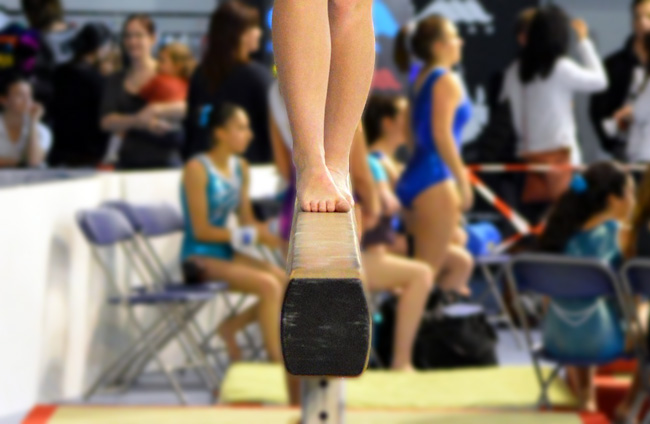
Walking the balance beam
Test Procedure
Procedure: The aim of this test is to walk the entire length of a standard gymnastics balance beam steadily, without falling off, and within a six second time span. The participant will start at one end, step up onto the beam, walk the length to the other end. The test is repeated three times.
Scoring: Participants are to be given three trials to complete the beam walk. The table below lists scores based on subjective observations of the beam walker. For more accuracy, use a team of three or more judges to observe a given individual perform. The score for each trial is the average of all the judge's scores. The overall score for the individual is the average of the three trial scores.
| Score | Description |
|---|---|
| 5 | Walks the balance beam flawlessly. Does not need to check balance, does not pause. Completes the walk within six seconds. |
| 4 | Walks the beam, but is somewhat unsteady. Completes the walk within six seconds. |
| 3 | Walks the beam, but is somewhat unsteady. May pause one or more times. Takes more than six seconds to complete the walk. |
| 2 | Walks the beam, but is very unsteady, almost falling off, may pause one or more times, and/or takes more than six seconds. |
| 1 | Falls off the beam before completing the walk. |
| 0 | Falls off the beam immediately. |
Understanding Your Score
The balance beam test score provides insight into your dynamic balance capabilities, which are crucial for athletic performance across many sports. Here's how to interpret your results in an athletic context:
Performance Categories
Elite Level (4.5-5.0): Demonstrates exceptional dynamic balance control comparable to competitive gymnasts. This level of performance indicates the neuromuscular coordination and proprioceptive awareness necessary for advanced gymnastics skills, figure skating, or other sports requiring precise balance on narrow surfaces.
Advanced Level (3.5-4.4): Shows strong dynamic balance abilities suitable for most competitive athletics. Athletes at this level can safely perform on elevated equipment and possess the balance foundation for learning complex movement patterns.
Intermediate Level (2.5-3.4): Displays adequate dynamic balance for recreational sports and fitness activities. Further balance training will enhance athletic performance and reduce injury risk, particularly for sports involving rapid direction changes or single-leg stability.
Beginner Level (1.5-2.4): Indicates developing balance skills that require focused training. Athletes should emphasize balance exercises in their training program, starting with stable surfaces before progressing to elevated beams.
Needs Training (0-1.4): Suggests significant balance deficits that should be addressed through systematic training. Begin with ground-based balance exercises, single-leg stands, and walking on wide, stable surfaces before attempting elevated beam work.
Sport-Specific Applications
The balance beam test has particular relevance for several athletic disciplines:
Gymnastics
This test serves as a fundamental screening tool for female gymnasts, as walking the beam is a basic prerequisite skill for gymnastics. Competitive gymnasts typically score 4.5 or higher, demonstrating the exceptional balance control required for performing complex skills on the regulation 10cm-wide beam. According to research by sports science expert Robert Wood, who has analyzed gymnastics performance data for over 25 years, elite gymnasts must develop this foundational balance before progressing to tumbling and acrobatic elements on the beam.
Figure Skating
Figure skaters require exceptional dynamic balance for executing jumps, spins, and footwork sequences on a narrow blade. The balance beam test provides a sport-specific assessment of the proprioceptive control and core stability necessary for maintaining edge control and body position during complex skating movements. Elite figure skaters typically achieve scores of 4.0 or above.
Dance and Performing Arts
Dancers, particularly ballet performers, benefit from superior dynamic balance for executing movements on relevé (on the toes), maintaining positions during turns, and performing traveling steps across the stage. The balance beam test assesses the ankle strength and proprioceptive awareness essential for dance performance. Professional dancers typically score in the 4.0-5.0 range.
Martial Arts
Many martial arts disciplines require dynamic balance for executing kicks, maintaining stances, and performing kata or forms. The balance beam test evaluates the single-leg stability and core control necessary for powerful striking techniques. Advanced martial artists generally score 3.5 or higher, with elite practitioners achieving 4.5+ scores.
General Athletic Performance
Dynamic balance is a foundational component of athletic performance across all sports. Research by Robert J. Wood, PhD in Exercise Physiology from the University of Western Australia and founder of Topend Sports, indicates that athletes with superior balance scores demonstrate better agility, reduced injury risk, and enhanced movement efficiency in their chosen sports.
How to Improve Your Balance Beam Performance
Systematic training can significantly improve balance beam test scores. Here are evidence-based strategies for athletic balance development:
Progressive Balance Training
Begin with stable surface balance exercises and progressively increase difficulty:
- Weeks 1-2: Single-leg stands on floor (30-60 seconds per leg), eyes open then closed
- Weeks 3-4: Walking on lines or narrow paths on the floor, tandem walking (heel-to-toe)
- Weeks 5-6: Low, wide beams (15-20cm wide, 10-15cm high) for walking practice
- Weeks 7-8: Progress to standard gymnastics beam (10cm wide) at increasing heights
- Weeks 9+: Add complexity through turns, backward walking, and dynamic movements on beam
Ankle and Core Strengthening
Ankle stability and core strength are primary determinants of balance beam performance:
- Ankle exercises: Calf raises (2-3 sets of 15-20 reps), single-leg hops, resistance band eversion/inversion exercises
- Core training: Planks (front and side, 30-60 seconds), bird-dogs (10-15 reps per side), anti-rotation exercises
- Frequency: 3-4 sessions per week for 4-6 weeks typically yields measurable improvements
Proprioceptive Training
Enhance body awareness through unstable surface training:
- Balance board exercises (circular board, wobble board)
- BOSU ball standing and squatting
- Foam pad single-leg exercises
- Eyes-closed variations of all balance exercises once proficient
Sport-Specific Practice
For gymnasts and athletes requiring beam skills, regular practice on the actual apparatus is essential. Start with supported practice (coach spotting or low beam with mats) and progressively increase independence and beam height as confidence and skill improve.
Test Reliability and Validity
Reliability: Three judges are used to improve reliability of assessors (Inter-rater reliability), and three trials per individual are allowed to improve reliability over time (Test-retest reliability). Using multiple judges and averaging three trials provides a coefficient of variation of less than 10% for trained assessors.
Validity: The balance beam test demonstrates face validity for assessing dynamic balance in athletic populations. The test replicates functional movement patterns required in gymnastics and other sports where balance on narrow surfaces is essential. Studies indicate strong correlations between balance beam performance and success in gymnastics competition, particularly for novice and intermediate level gymnasts.
Factors Affecting Performance
Several variables can influence balance beam test scores:
- Training background: Gymnasts and dancers typically outperform athletes from other sports due to sport-specific balance training
- Age: Balance performance peaks in young adulthood (ages 20-35) and gradually declines with aging, though training can mitigate these effects
- Footwear: Testing should be conducted barefoot or in minimal footwear to maximize proprioceptive feedback
- Beam width: Standard gymnastics beams (10cm wide) are specified for consistency; wider beams reduce test difficulty
- Fatigue: Testing should occur when athletes are rested; fatigue significantly impairs balance performance
- Visual focus: Athletes should maintain forward gaze toward beam end; looking down at feet typically reduces performance
Safety Considerations
The balance beam test involves elevated surfaces and potential fall risk. Implement these safety protocols:
- Use gymnastics mats or crash pads beneath and around the beam for all testing
- Ensure beam is stable and properly secured before testing begins
- Have spotters positioned on both sides of beam for novice performers
- Start with lower beam heights (30-50cm) for untrained individuals
- Screen participants for vestibular disorders, ankle injuries, or other conditions affecting balance
- Allow adequate familiarization trials before formal testing
- Stop testing immediately if participant experiences dizziness, pain, or excessive fear
Comments
This test can be used as a screening test for female gymnasts, as walking the beam is a basic skill for gymnastics. The subjective nature of the 0-5 scoring system allows judges to assess quality of movement, steadiness, and confidence—factors that are difficult to capture with purely objective measures like time or distance.
For longitudinal tracking of balance improvement, maintaining consistent testing conditions (same beam, same judges when possible, same time of day) enhances the ability to detect meaningful changes in performance over time.
Frequently Asked Questions
What is the balance beam test?
The balance beam test is a simple assessment of dynamic balance requiring a person to walk along an elevated gymnastics beam steadily without falling, ideally within six seconds. Performance is scored from 0-5 based on steadiness, balance checks, and completion time. It's primarily used for screening gymnasts and assessing dynamic balance in athletes requiring superior balance control.
How is the balance beam test scored?
Scores range from 0-5 based on subjective observation. Score 5 indicates flawless performance completing within 6 seconds with no balance checks. Score 4 shows minor unsteadiness but completes within time. Score 3 has noticeable unsteadiness and takes over 6 seconds. Score 2 is very unsteady with near-falls. Score 1 means falling before completion. Score 0 is an immediate fall.
How many trials are needed for the balance beam test?
The standard protocol uses three trials. Multiple trials improve test reliability by accounting for performance variability and reducing the impact of any single poor attempt. The final score is calculated by averaging all three trial scores, providing a more stable and representative measure of dynamic balance ability.
Can one person score the balance beam test?
Yes, a single judge can conduct the test, but using three or more judges significantly improves scoring reliability. Multiple judges provide more objective assessment by reducing individual scorer bias and improving inter-rater reliability. The calculator averages all judge scores for each trial to produce the most accurate final score.
What sports use the balance beam test?
The test is primarily used for female gymnasts as a basic screening tool since beam walking is fundamental to gymnastics. It's also valuable for assessing dynamic balance in figure skaters, dancers (especially ballet), martial artists, and any athletes requiring superior balance control on narrow surfaces or during single-leg movements.
How can I improve my balance beam test score?
Improve scores through progressive balance training starting with floor-based single-leg exercises, advancing to walking on narrow ground-level surfaces, then progressing to elevated beams. Strengthen ankles and core muscles through targeted exercises 3-4 times weekly. Practice proprioceptive training using unstable surfaces. Most athletes see measurable improvements within 4-6 weeks of consistent training.
What equipment is needed for the balance beam test?
You need a standard gymnastics balance beam (approximately 4 meters long, 10cm wide, elevated), a stopwatch for timing the 6-second target, recording sheets for documenting scores, and safety mats beneath and around the beam. Multiple judges should have clear viewing positions from different angles to assess balance and technique accurately.
References
- Bressel, E., Yonker, J.C., Kras, J., Heath, E.M. (2007). "Comparison of Static and Dynamic Balance in Female Collegiate Soccer, Basketball, and Gymnastics Athletes." Journal of Athletic Training, 42(1):42-46.
- Luong, T.N., Carlisle, H.J., Southwell, A., Patterson, P.H. (2011). "Assessment of Motor Balance and Coordination in Mice using the Balance Beam." Journal of Visualized Experiments, 49:e2376.
- Paillard, T., Noé, F. (2015). "Techniques and Methods for Testing the Postural Function in Healthy and Pathological Subjects." BioMed Research International, 2015:891390.
- Ringhof, S., Stein, T. (2018). "Biomechanical assessment of dynamic balance: Specificity of different balance tests." Human Movement Science, 58:140-147.
- Muehlbauer, T., Gollhofer, A., Granacher, U. (2015). "Associations Between Measures of Balance and Lower-Extremity Muscle Strength/Power in Healthy Individuals Across the Lifespan: A Systematic Review and Meta-Analysis." Sports Medicine, 45(12):1671-1692.
Similar Tests
- Balance Walk Test - 30-second pass/fail protocol on elevated beam
- Walk and Turn Field Sobriety Test - Law enforcement balance assessment
Related Pages
Balance Tests
Explore our complete collection of balance assessment protocols for athletes
View All Balance Tests →About Balance Testing
Learn about the science and methodology of balance assessment in sports
Learn More → Any comments, suggestions, or corrections? Please let us know.