Modified Bass Test of Dynamic Balance
Quick Answer
This calculator instantly scores your Modified Bass Test performance by calculating points from landing accuracy and balance hold duration. Results include your total score out of 150 points, performance percentage, athletic category rating, and sport-specific benchmarks.
- Calculates dynamic balance score from landing and balance errors
- Based on validated Modified Bass Test scoring protocol
- Provides athletic performance categories and training recommendations
Understanding the Modified Bass Test
The Bass test is an assessment of balance, in which the participants alternate foot hopping and holding a static position for five seconds at each point. The procedure described here is for the Modified Bass Test of Dynamic Balance test.
Purpose: to measure dynamic balance
Equipment required: adequate floor space, sticky tape for marking floor, measuring tape, stopwatch.
Pre-test: Explain the test procedures to the subject. Perform screening of health risks and obtain informed consent. Prepare forms and record basic information such as age, height, body weight, gender, test conditions. Perform an appropriate warm-up. See more details of pre-test procedures.
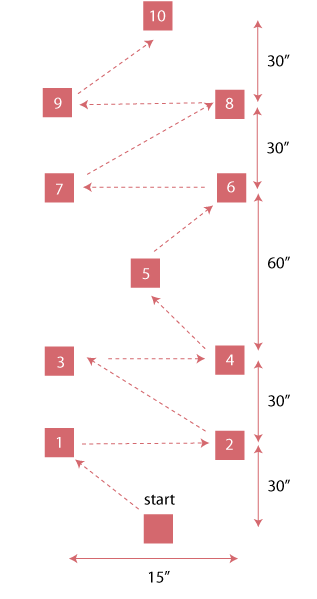 Procedure: The course is marked out as illustrated in the diagram. The subject begins by standing stationary on the right foot on the starting point square. The subject then hops to the first tape mark with the left foot and immediately holds a static position for five seconds. After this time, he then hops to the second tape mark with the right foot and holds a static position for another five seconds. This continues with alternate foot hopping and holding a static position for five seconds at each point until the course is completed. At each point, the sole of the foot must completely cover each tape mark so that it cannot be seen. A period of practice with the procedure and on the course should be allowed.
How to Score the Modified Bass Test
The Modified Bass Test uses a comprehensive scoring system that evaluates both dynamic (hopping) and static (balance hold) components:
Landing Component (100 Points Maximum)
- 10 points per marker are awarded for successful landings
- A successful landing covers the tape mark completely with the ball of the foot
- Landing errors include: touching the floor with heel or other body part, failing to cover the tape mark completely
- Maximum deduction: 100 points (10 markers × 10 points each)
Balance Hold Component (50 Points Maximum)
- 5 points per marker for maintaining balance for the full 5 seconds
- 1 point deducted for each second of balance error
- Balance errors include: moving the planted foot, touching floor with other body part, exposing the tape mark
- Maximum: 50 points (10 markers × 5 seconds each)
Total Score Calculation
Your total score = Landing Points + Balance Hold Points, with a maximum possible score of 150 points.
Performance Categories and Athletic Standards
Performance on the Modified Bass Test is interpreted using percentage scores, which account for individual variations in athletic ability and training background:
Scoring Categories
- Excellent (90-100%): Elite-level dynamic balance characteristic of competitive gymnasts, professional dancers, and Division I athletes
- Good (80-89%): Above-average balance suitable for varsity-level competition and serious athletic training
- Average (70-79%): Adequate balance for recreational sports and general fitness activities
- Below Average (60-69%): Balance training recommended for athletic development and injury prevention
- Poor (<60%): Significant balance deficits requiring focused intervention
Sport-Specific Applications
Gymnastics and Acrobatics
Elite gymnasts typically score 140-150 points (93-100%) on the Modified Bass Test, reflecting the exceptional dynamic balance required for apparatus work, tumbling, and aerial maneuvers. Youth competitive gymnasts generally achieve 120-140 points (80-93%), while recreational gymnasts score 105-125 points (70-83%).
Dance and Figure Skating
Professional dancers and elite figure skaters demonstrate scores of 135-148 points (90-98%), with particular strength in the balance hold component. The test effectively predicts performance in movements requiring sustained single-leg balance and rapid weight transfers between legs.
Team Sports
Basketball players average 112-130 points (75-87%), soccer players 108-125 points (72-83%), and football players 105-120 points (70-80%). Position-specific variations exist, with guards and midfielders typically scoring higher than linemen and forwards due to greater agility demands.
Combat Sports
Martial artists and boxers score 115-135 points (77-90%), with the test serving as a valuable predictor of striking accuracy and defensive movement capability. Single-leg balance holds directly correlate with kicking power and stability during combinations.
Improving Your Modified Bass Test Score
Foundational Balance Training
Begin with static single-leg balance holds on stable surfaces, progressing from eyes open to eyes closed. Start with 30-second holds per leg and build to 2-3 minutes. Practice 3-4 times per week, performing 3-4 sets per session.
Dynamic Balance Progression
Once static holds are mastered, progress to dynamic exercises:
- Single-leg hops: Forward, lateral, and rotational patterns (3 sets of 10 reps per leg)
- Hop-and-hold sequences: Replicate the Bass test pattern with shorter distances initially
- Single-leg Romanian deadlifts: Build strength and control (3 sets of 8-12 reps)
- Lateral bounds with stabilization: Explosive side-to-side movement with 3-second holds (3 sets of 6-8 reps per side)
Proprioceptive Training
Incorporate unstable surfaces like foam pads, wobble boards, or BOSU balls after establishing proficiency on stable ground. Research shows that 6-8 weeks of proprioceptive training can improve dynamic balance scores by 15-25% in trained athletes.
Sport-Specific Drills
Integrate balance challenges into sport movements: single-leg catches for basketball, landing mechanics for volleyball, cutting patterns for soccer. This transfer training enhances both test performance and sport-specific balance application.
Test Reliability and Limitations
Research by Johnson and Leach (1986) established the Modified Bass Test with good to excellent inter-rater reliability (ICC = 0.82), making it suitable for clinical and athletic assessment. However, several limitations should be considered:
Advantages
- Simple to perform with minimal equipment requirements
- Assesses both static and dynamic balance components
- Provides quantifiable scoring for tracking progress
- Applicable across diverse athletic populations
- Strong correlation with injury risk in several sports
Limitations
- Fixed distances favor taller athletes: The standard marker distances (fixed for all participants) create advantages for individuals with longer leg lengths, potentially skewing comparisons between athletes of different heights
- Practice effects: Familiarity with the test course can improve scores by 10-15% even without actual balance improvements
- Limited upper body assessment: The test does not control for arm movements or upper body compensations that may mask true lower body balance deficits
- Pass/fail nature: The original scoring system (success/fail) provides limited differentiation; the calculator's point system offers better discrimination
Frequently Asked Questions
What is a good score on the Modified Bass Test?
A score of 135-150 points (90-100%) is considered excellent, indicating elite-level dynamic balance suitable for competitive athletics. Scores of 120-134 (80-89%) represent good balance for most sports, while 105-119 (70-79%) is average for recreational athletes. Individual sport requirements vary, with gymnastics and dance typically requiring higher scores than team sports.
How is the Modified Bass Test different from other balance tests?
The Modified Bass Test uniquely combines dynamic (hopping between markers) and static (balance hold) components, unlike the Y Balance Test which uses reaching movements or the Balance Error Scoring System which only assesses static positions. This makes it particularly valuable for sports requiring rapid changes between movement and stabilization, such as basketball, soccer, and martial arts.
How often should I test my dynamic balance?
For athletes in training, monthly testing provides adequate frequency to track improvements without excessive practice effects. During intensive balance training programs, test every 4-6 weeks. Pre-season and post-season testing helps evaluate off-season training effectiveness. After injury, test at return-to-play and again 4-6 weeks post-return to ensure full recovery.
Can the Modified Bass Test predict injury risk?
Research indicates that athletes scoring below 70% on the Modified Bass Test have 2-3 times higher risk of lower extremity injuries, particularly ankle sprains and ACL injuries. However, the test should be used as part of comprehensive screening alongside strength testing, movement quality assessment, and sport-specific functional tests rather than as a sole injury risk predictor.
How long does it take to improve balance scores?
With consistent training 3-4 times per week, most athletes see 10-15% improvement within 4-6 weeks. Beginners may experience faster initial gains (20-30% in 6-8 weeks), while elite athletes may only improve 5-10% over the same period. Neurological adaptations occur first (2-3 weeks), followed by strength and proprioceptive improvements (4-8 weeks).
Should I practice the test before assessment?
Yes, 2-3 familiarization trials are recommended to reduce anxiety and ensure proper technique understanding without significantly affecting test validity. Full practice sessions should be avoided before formal testing as they can inflate scores by 10-15% through motor learning rather than actual balance improvement. For baseline assessment, minimal familiarization provides the most accurate representation of current ability.
What factors affect Modified Bass Test performance?
Key factors include: leg length (taller athletes have advantages with fixed marker distances), previous ankle injuries (can reduce scores by 15-25%), fatigue status (performance drops 10-20% when fatigued), footwear (minimal shoes generally improve proprioception), age (peak performance typically occurs ages 20-28), and training background (gymnasts and dancers score 15-30% higher than untrained individuals).
References
- Johnson, B. L., & Leach, J. (1986). A modification of the Bass test of dynamic balance. Measurement and Evaluation in Guidance, 19, 115-120.
- Hrysomallis, C. (2011). Balance ability and athletic performance. Sports Medicine, 41(3), 221-232.
- Davlin, C. D. (2004). Dynamic balance in high level athletes. Perceptual and Motor Skills, 98(3), 1171-1176.
- Brachman, A., Kamieniarz, A., Michalska, J., Pawłowski, M., Słomka, K. J., & Juras, G. (2017). Balance training programs in athletes: A systematic review. Journal of Human Kinetics, 58, 45-64.
- Plisky, P. J., Rauh, M. J., Kaminski, T. W., & Underwood, F. B. (2006). Star Excursion Balance Test as a predictor of lower extremity injury in high school basketball players. Journal of Orthopaedic & Sports Physical Therapy, 36(12), 911-919.
Related Pages
- The Multiple Single-Leg Hop-Stabilization Test (MSLHST) is a dynamic and static balance test developed from the Bass test
- Other balance tests
- About balance testing
 Any comments, suggestions, or corrections? Please let us know.