Astrand-Rhyming Cycle Ergometer Test Calculator
Quick Answer
The Astrand-Rhyming test estimates your VO2 max (maximal aerobic capacity) from a single 6-minute submaximal cycling effort. Simply pedal at a constant workload that maintains your heart rate between 125-170 bpm, then use the calculator above for instant results with automatic age correction and cycling-specific performance categories.
- Valid correlation of 0.85-0.90 with directly measured VO2 max
- Based on validated Åstrand formulas (Buono et al. 1989)
- Proven reliable for athletes across all endurance sports
About the Astrand-Rhyming Cycle Ergometer Test
The Astrand Test is a submaximal cycle ergometer aerobic fitness test, based on the relationship between heart rate during work and percentage of maximal aerobic capacity. The original test method and nomogram (Åstrand, P.-O. & Ryhming, I., 1954) was later expanded and modified (Åstrand, I., 1960) with a nomogram accounting for men and women of different ages. There are many other cycling tests and aerobic fitness tests, such as the similar YMCA Cycle ergometer submaximal test.
Equipment Required
Equipment required: cycle ergometer, clock or stopwatch, heart rate monitor, ECG monitor (optional)
Pre-Test Procedures
Pre-test: Explain the test procedures to the subject. Perform screening of health risks and obtain informed consent. Prepare forms and record basic information such as age, height, body weight, gender, test conditions. Calibrate and adjust the cycle ergometer. Attach heart rate monitor. See more details of pre-test procedures.
Test Protocol and Procedure
Description: Allow the subject to warm‐up on the cycle ergometer for 2 to 3 minutes with a resistance of 0 kg and at a cadence of 50. Following this, the subject pedals for 6 minutes at a workload chosen to try and elicit a steady-state heart rate between 125 and 170 bpm. As a guide, the initial workload for men is between 300-600 kp/m/min (unconditioned) and 600-900 (conditioned). For women, 300-450 kp/m/min (unconditioned) and 450-600 (conditioned). Record heart rate every minute during the test. If the heart rate at 5 and 6 minutes is not within 5 beats/min, continue for one extra minute. If the steady-state heart rate achieved is not between 125 and 170 bpm, adjust the workload appropriately and continue for a second 6 minute period. Otherwise, the test is completed.
Scoring Methods
Nomogram Method
Scoring (nomogram): Generally the lower the steady-state heart rate the better your fitness. The steady-state heart rate and workload are looked up on the nomogram to determine an estimation of VO2max.
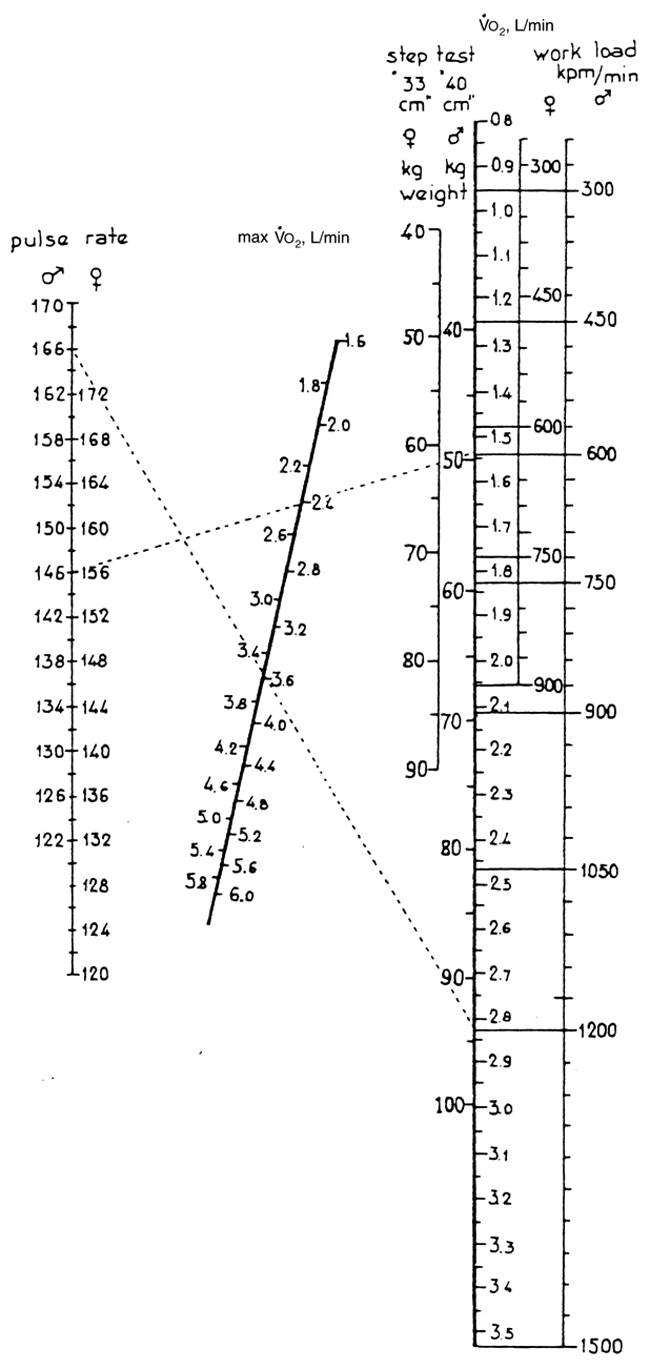 Astrand scoring nomogram (Åstrand, I., 1960)
Formula Method
Scoring (formula): Here is also the formula (Buono et al. 1989) that the nomogram is based on, where predicted VO2max is in L/min, HRss is the steady heart rate after 6 min of exercise, and the workload in kg.m/min. To convert a load in watts to kg.m/min, multiply the watts by 6.12.
females: VO2max = (0.00193 x workload + 0.326) / (0.769 x HRss - 56.1) x 100
males: VO2max = (0.00212 x workload + 0.299) / (0.769 x HRss - 48.5) x 100
Age Correction
Age correction: There is an age correction factor to adjust the score depending on the age of the subject. Extrapolate the correction factor for ages between those listed.
| Age | Correction Factor |
|---|---|
| 15 | 1.10 |
| 25 | 1.00 |
| 35 | 0.87 |
| 40 | 0.83 |
| 45 | 0.78 |
| 50 | 0.75 |
| 55 | 0.71 |
| 60 | 0.68 |
| 65 | 0.65 |
Understanding Your VO2 Max Results
Your VO2 max represents your body's maximum capacity to consume and utilize oxygen during intense exercise. For cyclists and endurance athletes, this metric is fundamental to performance potential. Elite male cyclists typically achieve values of 70-85 ml/kg/min, while elite female cyclists reach 60-70 ml/kg/min. Professional Tour de France riders often exceed 80 ml/kg/min, with some reaching the mid-90s.
However, VO2 max alone doesn't determine cycling success. Equally important is your fractional utilization - the percentage of your VO2 max you can sustain for extended periods. A cyclist with a VO2 max of 70 ml/kg/min who can sustain 75% of it will often outperform a rider with 75 ml/kg/min who can only sustain 60%. This is why structured training focuses on both improving VO2 max and increasing the intensity you can maintain.
VO2 Max Categories for Cyclists
| Category | Male (ml/kg/min) | Female (ml/kg/min) | Performance Level |
|---|---|---|---|
| Elite Cyclist | 75+ | 65+ | Professional/National level |
| Highly Trained | 65-74 | 55-64 | Regional competitive |
| Well Trained | 55-64 | 45-54 | Club racing level |
| Active Cyclist | 45-54 | 38-44 | Regular training |
| Average Fitness | 35-44 | 30-37 | Recreational rider |
| Below Average | <35 | <30 | Beginner cyclist |
Sport-Specific Applications
Road Cycling
Road cyclists benefit from high VO2 max during climbing, breakaways, and sustained high-intensity efforts. Professional climbers like Tadej Pogačar and Jonas Vingegaard possess VO2 max values in the high 80s to low 90s ml/kg/min. For amateur road racers, values above 60 ml/kg/min for men and 50 ml/kg/min for women provide a competitive foundation for regional racing.
Time Trial and Triathlon
Time trialists and triathletes require sustained power at threshold, which correlates more closely with fractional utilization than absolute VO2 max. Elite triathletes typically achieve VO2 max values of 70-80 ml/kg/min for men and 60-68 ml/kg/min for women. Training focuses on maintaining high percentages of VO2 max for extended durations (20-60 minutes).
Track Cycling
Track cycling demands vary by discipline. Pursuit riders need VO2 max similar to road cyclists (65-80 ml/kg/min), while sprinters may have slightly lower aerobic capacity but exceptional anaerobic power. The 4000m individual pursuit directly stresses VO2 max systems, making it an excellent event for riders with elite aerobic capacity.
Mountain Biking
Cross-country mountain bikers require VO2 max values comparable to road cyclists, typically 60-75 ml/kg/min for competitive men and 50-65 ml/kg/min for women. The intermittent nature of mountain biking also demands strong anaerobic capacity and the ability to recover quickly during descents while operating at high percentages of VO2 max on climbs.
How to Improve Your VO2 Max
Research demonstrates that VO2 max is highly trainable, with potential improvements of 15-30% possible through structured training. Even athletes who have trained for years can see gains of 10-15% with targeted VO2 max intervals. The key is consistent, progressive training that challenges your cardiovascular system.
VO2 Max Interval Training
High-intensity intervals at 90-100% of VO2 max are the most effective way to improve aerobic capacity. Typical workouts include:
- Classic VO2 Max Intervals: 4-6 x 4 minutes at 110-120% FTP with 4 minutes recovery
- Short Repeats: 8-10 x 2 minutes at 120% FTP with 2 minutes recovery
- Pyramid Structure: 2-3-4-5-4-3-2 minutes building to VO2 max power
- 30/30s: 12-20 x 30 seconds hard / 30 seconds easy for neuromuscular recruitment
Threshold Training
While VO2 max intervals build your ceiling, threshold training improves your ability to sustain high percentages of it. Include 2 x 20 minute efforts at 85-92% of VO2 max (typically your functional threshold power) twice weekly.
Endurance Base
Aerobic base training (Zone 2, 60-70% max HR) increases mitochondrial density and capillarization in muscles, improving oxygen extraction. Maintain 5-8 hours weekly of steady endurance riding even during focused VO2 max training blocks.
Test Validity and Limitations
Validity: the correlation to VO2max is approximately 0.85 - 0.90, with a standard error of estimate around 5-6 ml/kg/min. Research by Cink and Thomas (1981) and Legge and Banister (1986) confirmed the nomogram's reliability when heart rate responses fall within the recommended range.
Advantages: this is a simple test to administer, reasonably accurate and appropriate for ECG monitoring during exercise. The submaximal nature makes it safer than maximal tests for cardiac patients and older adults. It requires minimal equipment and can be performed in most fitness facilities.
Disadvantages: the test score would be influenced by the variability in maximum heart rate in individuals. It would underestimate the fitness of those with a high maximum heart rate, and overestimate fitness with advancing age (as max HR reduces with age). As it is performed on a cycle ergometer, it would favor cyclists. Medications affecting heart rate (beta-blockers, calcium channel blockers) and caffeine consumption can impact accuracy. The test assumes a linear heart rate-VO2 relationship, which may not hold for extremely fit or unfit individuals.
Frequently Asked Questions
How accurate is the Astrand cycle test for VO2 max?
The Astrand-Rhyming test has a correlation of 0.85-0.90 with directly measured VO2 max, with a standard error of approximately 5-6 ml/kg/min. Research shows it provides reliable estimates when heart rate is maintained between 125-170 bpm and age corrections are properly applied. For most athletes, this accuracy is sufficient for tracking training progress and comparing fitness levels.
What is a good VO2 max for cyclists?
For male cyclists, 50-60 ml/kg/min is considered good fitness, 60-70 is highly trained, and above 70 is elite level approaching professional standards. Female cyclists typically score 45-55 ml/kg/min for good fitness, 55-60 for highly trained, and above 60 for elite performance. Professional Tour de France cyclists often exceed 80 ml/kg/min. However, cycling performance depends equally on fractional utilization and efficiency, not just absolute VO2 max.
What workload should I use for the Astrand test?
Initial workload should elicit a heart rate of 125-170 bpm during the 6-minute test. For unconditioned men, start at 300-600 kg.m/min (50-100 watts); conditioned men 600-900 kg.m/min (100-150 watts). For unconditioned women, 300-450 kg.m/min (50-75 watts); conditioned women 450-600 kg.m/min (75-100 watts). If heart rate falls outside the target range, adjust workload and repeat the test.
How does the Astrand test compare to YMCA submaximal test?
Both are valid submaximal cycle tests with similar accuracy. The Astrand test uses a single 6-minute workload while the YMCA uses multiple 3-minute stages at progressively higher intensities. The Astrand test is quicker and simpler (about 10 minutes total including warm-up), while the YMCA test may be more accurate for very fit or unfit individuals by using multiple heart rate responses to create a more reliable extrapolation.
Can I improve my VO2 max through training?
Yes, VO2 max is highly trainable. Research shows beginners can improve 10-20% in 4-12 months with regular training three times weekly. Even advanced athletes can see 15% gains in 4-6 weeks with targeted VO2 max intervals. Long-term improvements of 25-30% are possible with consistent structured training over 1-2 years. The least fit individuals see the biggest percentage gains, while elite athletes have smaller room for improvement but can still optimize their capacity.
Why must heart rate be between 125-170 bpm?
This heart rate range represents approximately 50-85% of maximum heart rate where the linear relationship between heart rate and oxygen consumption is most reliable. Below 125 bpm, the test tends to underestimate VO2 max because small variations in effort produce minimal heart rate changes. Above 170 bpm, accuracy decreases due to cardiovascular drift, anaerobic contribution, and non-linear heart rate responses approaching maximum.
How often should I test my VO2 max?
Test every 4-8 weeks during focused training blocks to monitor progress and adjust training zones. Avoid testing within 3-4 days of hard training or competition as fatigue will artificially lower results. For cycling-specific testing, schedule tests during base training phases and after completing 4-6 week blocks of VO2 max interval work. More frequent testing (every 2-3 weeks) may be warranted when closely monitoring adaptation to a new training stimulus.
References
- Åstrand, I. (1960). "Aerobic work capacity in men and women with special reference to age." Acta Physiologica Scandinavica, vol. 49, suppl 169.
- Åstrand, P.-O. & Ryhming, I. (1954). "A nomogram for calculation of aerobic capacity (physical fitness) from pulse rate during submaximal work." J Appl Physiol, 7, page 218-221.
- Astrand PO, Rodahl K. (1986). Text Book of Work Physiology: Physiological basis of exercise. New York: McGraw Hill.
- Buono MJ, Roby JJ, Micale FG, Sallis JF. (1989). "Predicting maximal oxygen uptake in children: modification of the Astrand-Ryhming test." Pediatric Exercise Science, 1:278-283.
- Cink RE, Thomas TR. (1981). "Validity of the Astrand-Ryhming nomogram for predicting maximal oxygen intake." British Journal of Sports Medicine, Vol 15, Issue 3, 182-185.
- Legge B, Banister EW. (1986). "The Astrand-Rhyming nomogram revisited." J Appl Physiol, 61: 1203-1209.
- Costill DL, Wilmore JH, Kenney WL. (1994). Physiology of Sport and Exercise. Human Kinetics.
- Ekblom-Bak E, Björkman F, Hellenius ML, Ekblom B. (2014). "A new submaximal cycle ergometer test for prediction of VO2max." Scand J Med Sci Sports, 24:319-326.
- Siconolfi SF, Cullinane EM, Carleton RA, Thompson PD. (1982). "Assessing VO2max in epidemiologic studies: modification of the Astrand-Rhyming test." Med Sci Sports Exerc, 14(5):335-8.
- Couzens A. (2014). "VO2max improvements in endurance athletes." Sports Science Insights.
Similar Tests
Related Pages
- Fitness tests for cyclists
- Cycling Fitness Tests - assessments involving cycling exercise
- Cycle Ergometers - equipment guide
- Other aerobic fitness tests
- More information on measuring heart rate
- Profile of Per-Olof Åstrand
 Any comments, suggestions, or corrections? Please let us know.