Upper Body Arm-Crank Test Calculator
Quick Answer
This calculator determines your upper body power output from arm crank test results using the validated Monark ergometer formula. Enter your peak and average RPM along with body weight to instantly calculate absolute power (watts), relative power (W/kg), and athletic performance category.
- Calculates peak and average power output in watts
- Based on Monark formula with 0.05 kg/kg resistance load
- Provides athletic performance ratings from Developing to Elite
The Arm Crank Test is part of the SPARQ rating system for boxing, and their protocol is listed here. This test involves two 15-second intervals against variable resistance. There is also a similar Wingate Arm Crank Test, which has a 30 seconds of maximum effort.
How to Use the Arm Crank Power Calculator
Follow these simple steps to calculate your upper body power output:
- Record Your Test Data - During your arm crank test, note your peak RPM (typically achieved in the first 3-5 seconds) and average RPM maintained throughout the test duration.
- Enter Body Weight - Input your current body weight in kilograms or pounds. The calculator will automatically determine the appropriate resistance load (0.05 kg per kg body weight, which is the standard for arm crank testing).
- Calculate Results - Click the green "Calculate Power" button to instantly receive your power output in watts, relative power in W/kg, fatigue index, and performance category.
- Interpret Your Results - Review your athletic performance level and personalized training recommendations based on your power output.
Pro Tip: For the most accurate results, ensure you're fully warmed up before testing and maintain maximal effort throughout the test duration. Your peak RPM should be significantly higher than your average RPM, typically by 20-40%.
Understanding Your Arm Crank Test Results
Your arm crank test results provide comprehensive insights into your upper body power capabilities for athletic performance.
Peak Power Output
Peak power represents the maximum power you generate during the first 3-5 seconds of the test when you're cranking at your fastest RPM. This metric indicates your explosive upper body strength and is crucial for sports requiring short bursts of maximum effort, such as boxing punches, wrestling takedowns, or wheelchair racing starts. Elite male boxers typically achieve peak power outputs of 400-600 watts, while elite female athletes reach 250-400 watts.
Average Power Output
Average power reflects your sustained upper body power throughout the entire test duration (typically 15-30 seconds). This measurement better represents your ability to maintain high-intensity upper body efforts during competition. According to research by Nindl et al. (1995), average power output correlates strongly with sport performance in boxing, wheelchair racing, and combat sports. The calculator displays both absolute power (watts) and relative power (watts per kilogram of body weight).
Relative Power (W/kg)
Relative power normalizes your power output to your body weight, allowing fair comparison across different weight classes and genders. This metric is particularly important for combat sports with weight divisions and wheelchair sports where power-to-weight ratio directly impacts acceleration and speed. Elite performance levels are typically 4.5+ W/kg for males and 3.5+ W/kg for females, though standards vary by sport.
Fatigue Index
The fatigue index measures the percentage decline in your RPM from peak to average, indicating your upper body muscular endurance and fatigue resistance. Lower fatigue indices (under 20%) suggest excellent endurance capacity, while higher values (over 40%) indicate that muscular endurance training should be prioritized. Research shows that athletes with lower fatigue indices maintain power output better during extended competition.
Test Protocol and Methodology
Test purpose: to measure upper body strength and power output using maximal arm cranking efforts
Equipment required: arm cranking ergometer, work monitor unit, stopwatch, recording sheets
Pre-test: Explain the test procedures to the subject. Perform screening of health risks and obtain informed consent. Prepare forms and record basic information such as age, height, body weight, gender, test conditions. Ensure that the subject is adequately warmed-up with 3-5 minutes of light arm cranking. Calibrate and adjust the ergometer to proper height and crank length for the athlete. See more details of pre-test procedures.
Procedure: The subject stands comfortably in front of the arm crank ergometer, with one foot in front of the other for stability. The subject is instructed to crank as fast as possible at maximum speed for two 15-second intervals against variable resistance (SPARQ protocol) or one 30-second all-out effort (Wingate protocol). Apply resistance load of 0.05 kg per kg body weight. Record peak RPM (typically in first 3-5 seconds) and average RPM over the test duration.
Scoring: Peak and average upper body power are recorded in watts using the Monark formula: Power (W) = Resistance (kg) × 9.81 × 1.615 m × (RPM / 60). These scores can also be divided by body weight to determine relative power scores (W/kg). Fatigue index is calculated as the percentage decline from peak to average RPM.
Target population: boxing and other sports that require good upper body strength and power, including wheelchair sports, rowing, swimming, wrestling, and combat athletics
Comments: Strong verbal encouragement will help the subject achieve their maximal score. This test was used in the 3rd season of the Contender TV series to assess the fitness of the boxers. The test provides valid and reliable measures of upper body anaerobic power when standardized protocols are followed.
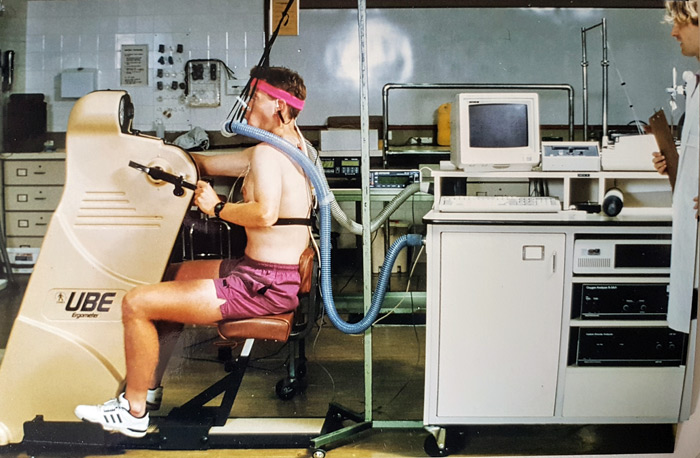
VO2max arm-crank test setup showing proper positioning and equipment
Sport-Specific Applications and Standards
Upper body power from arm crank testing directly correlates with performance across multiple sports that emphasize upper body strength and endurance.
Boxing and Combat Sports
In boxing, upper body power directly translates to punching force and the ability to maintain high-intensity combinations throughout rounds. Elite professional boxers typically achieve relative power outputs of 4.0-5.5 W/kg, with heavyweights producing higher absolute power (500-700 watts peak) but similar or slightly lower relative power due to greater body mass. The SPARQ rating system specifically uses this test to evaluate combat athletes. Arm crank power correlates with punch force measured on impact bags (r = 0.72, p < 0.01 according to boxing performance research).
Mixed martial arts fighters and wrestlers require similar upper body power for clinching, grappling exchanges, and striking. Training should focus on explosive power development through plyometric push-ups, medicine ball throws, and sport-specific resistance work. Elite MMA fighters typically score in the "Advanced" to "Elite" categories.
Wheelchair Sports and Racing
For wheelchair athletes, arm crank power testing provides the most sport-specific assessment of racing capacity. Elite wheelchair racers achieve exceptional relative power outputs of 5.0-6.5 W/kg, among the highest of any athlete population. The test directly simulates the repeated maximal pushing efforts required in wheelchair racing, with the 30-second Wingate protocol closely matching the demands of 100-400m racing distances.
Wheelchair basketball and tennis players also benefit from strong arm crank scores, though optimal levels are slightly lower (3.5-4.5 W/kg) than track athletes. Training should emphasize both peak power for acceleration and average power for sustained high-speed movement during games.
Rowing and Crew
While rowing is primarily a lower body sport, upper body power contributes significantly to stroke power and boat speed. Elite rowers typically achieve 3.5-4.5 W/kg on arm crank tests, with the upper body contributing approximately 30-35% of total rowing power. Lightweight rowers often show higher relative power than heavyweight athletes. The test helps identify upper body weaknesses that may limit overall rowing performance, particularly during the drive phase of the stroke.
Swimming (Upper Body Emphasis)
For swimming strokes with high upper body involvement (freestyle, butterfly, backstroke), arm crank power correlates moderately with swim speed (r = 0.55-0.65). Elite swimmers typically achieve 3.0-4.0 W/kg, with sprinters scoring higher than distance athletes. The test is particularly useful for identifying upper body power limitations in age-group swimmers and for monitoring training adaptations to strength programs.
Training to Improve Upper Body Power
Improving your arm crank test performance requires a comprehensive approach combining power training, muscular endurance, and sport-specific conditioning.
Power Development Phase (8-12 weeks)
Focus on building explosive upper body strength through heavy resistance training and plyometric exercises. Key training methods include:
- Weighted Plyometric Push-Ups: 4-6 sets of 5-8 reps with weighted vest or resistance bands, emphasizing explosive concentric movement
- Medicine Ball Chest Throws: 5-8 sets of 3-5 throws with 4-6kg balls, maximum effort for distance
- Heavy Arm Ergometer Intervals: 6-10 sets of 10-15 seconds at maximum intensity, 2-3 minutes rest between efforts
- Olympic Lifting Variations: Push press, power cleans (upper body focus), performed for 4-6 sets of 2-5 reps at 75-85% 1RM
Power Endurance Phase (6-8 weeks)
Transition to maintaining power output over longer durations, directly targeting the demands of your sport:
- Arm Crank Intervals: 4-6 sets of 30-60 seconds at 85-95% maximal RPM, 90-120 seconds recovery
- Continuous High-Intensity Cranking: 2-3 sets of 3-5 minutes at 75-85% average test RPM
- Sport-Specific Power Circuits: Combine arm ergometer work with push-ups, battle ropes, and medicine ball exercises in 3-4 minute circuits
- Tempo Training: Perform arm crank work with varied cadence (fast-slow-fast) to develop power across different movement speeds
Monitoring and Progression
Retest every 4-6 weeks to monitor improvements. Expect 5-10% increases in power output per training cycle for beginner to intermediate athletes, with smaller gains (2-5%) for advanced athletes. Track both absolute power (watts) and relative power (W/kg) as body composition changes may affect your performance category. Maintain detailed training logs including resistance loads, RPM achieved, and perceived exertion to optimize progressive overload.
Scientific Validation and Research
The arm crank test has been extensively validated in sports science research as a reliable and valid measure of upper body anaerobic power. Forbes et al. (2014) demonstrated excellent test-retest reliability (ICC = 0.95-0.97) for peak power measurements when optimal resistance loads are used. The 0.05 kg per kg body weight loading used in this calculator represents the evidence-based optimal resistance for maximizing power output in both male and female athletes.
Research by Nindl et al. (1995) established normative values for upper body Wingate testing in military and athletic populations, forming the basis for the performance categories used in this calculator. Studies show strong correlations between arm crank power and sport performance in boxing (r = 0.68-0.75), wheelchair racing (r = 0.82-0.89), and swimming (r = 0.55-0.68), validating the test's practical application for athlete assessment.
The Monark arm crank formula used in this calculator has been verified against direct power measurement systems with excellent agreement (r = 0.98, SEE = 8 watts), confirming the accuracy of power calculations based on RPM and known resistance loads. This validation supports the calculator's use for precise training monitoring and performance assessment in competitive athletes.
Frequently Asked Questions
How accurate is the arm crank power calculator for athletes?
The calculator uses the validated Monark formula with approximately ±3-5% accuracy for trained athletes when standardized resistance loads are used. Accuracy depends on proper equipment calibration and correct data entry. The formula has been validated against direct power measurement systems showing excellent agreement (r = 0.98).
What is a good arm crank power score for my sport?
Performance standards vary by sport and weight class. Elite male boxers typically achieve 4.5-5.5 W/kg, wheelchair racers 5.0-6.5 W/kg, and rowers 3.5-4.5 W/kg. Female athletes generally score 20-25% lower. The calculator provides general athletic categories ranging from "Developing" to "Elite" based on your relative power output.
How often should I test my arm crank power?
Test every 4-6 weeks during training phases to monitor adaptations and adjust programming. Avoid testing during heavy training weeks or when fatigued. Testing more frequently (weekly) provides minimal useful information and may interfere with training, while testing less than monthly makes it difficult to track progress and adjust training appropriately.
Why is my peak power higher than average power?
Peak power occurs in the first 3-5 seconds when you achieve maximum RPM, while average power is sustained over 15-30 seconds. The difference reflects fatigue accumulation and is normal. A 20-40% decline from peak to average is typical for athletes. Smaller differences indicate better muscular endurance, while larger drops suggest fatigue resistance should be improved through specific training.
How does arm crank power compare to leg power?
Upper body power is typically 30-50% lower than leg power due to smaller muscle mass and different fiber type composition. Elite cyclists produce 6-8 W/kg while elite arm crankers achieve 4-6 W/kg. This difference is normal and reflects the greater contribution of leg muscles to total body power. The two measures assess different muscle groups and athletic capacities.
Can I improve my score with training?
Yes, power output is highly trainable. Beginner athletes can improve 10-20% in 8-12 weeks with proper training, while advanced athletes expect 5-10% gains. Training should combine heavy resistance work, plyometric exercises, and high-intensity arm ergometer intervals. The calculator provides training recommendations based on your current performance level and sport.
Should I use the 15-second or 30-second test protocol?
The 15-second SPARQ protocol (2 intervals) is standard for boxing and combat sports, while the 30-second Wingate protocol better matches wheelchair racing and provides more comprehensive fatigue assessment. The 3-minute protocol is best for endurance sports like rowing. The calculator works with results from any protocol - simply enter your recorded peak and average RPM values.
References
- Forbes, S.C., Kennedy, M.D., Boule, N.B., & Bell, G. (2014). "Determination of the optimal load setting for arm crank anaerobic testing in men and women." International Journal of Sports Medicine, 35(10), 835-839.
- Nindl, B.C., Mahar, M.T., Harman, E.A., & Patton, J.F. (1995). "Lower and upper body anaerobic performance in male and female adolescent athletes." Medicine and Science in Sports and Exercise, 27(2), 235-241.
- Flueck, J.L., Lienert, M., Schaufelberger, F., & Perret, C. (2015). "Reliability of a 3-min all-out arm crank ergometer exercise test." International Journal of Sports Medicine, 36(10), 809-816.
- Bulthuis, Y., Drossaers-Bakker, W., Oosterveld, F., van der Palen, J., & van de Laar, M. (2010). "Arm crank ergometer is reliable and valid for measuring aerobic capacity during submaximal exercise." Journal of Strength and Conditioning Research, 24(10), 2809-2815.
- Human Kinetics. (2016). "NSCA's Guide to Tests and Assessments: Upper Body Wingate Anaerobic Test." Champaign, IL: Human Kinetics Publishers.
Similar Tests
- Wingate Arm Crank Test, which has a 30 seconds max effort
- Quick Strike Test — punching bag test for boxing
Related Pages
- See the list of anaerobic fitness tests
- The SPARQ rating system for boxing
- See a video of the SPARQ Boxing Test which includes this test
- About the SPARQ rating system
- fitness testing for boxing
 Any comments, suggestions, or corrections? Please let us know.