Straight Leg Lift Abdominal Strength Test Calculator
Quick Answer
This calculator interprets your straight leg lowering test results using research-based norms. Enter the angle where your lower back lost contact with the floor to get your core strength rating and personalized training recommendations.
- Compares to age and gender norms from published research
- Based on validated double leg lowering test methodology
- Provides sport-specific training guidance for athletes
Understanding the Straight Leg Lowering Test
The Straight Leg Lift test is a test of abdominal strength, in which the participants slowly lower the straightened legs. This test is important to conduct as poor abdominal muscle strength can cause poor posture leading to lower back pain.
Test purpose: The purpose of this test is to estimate the degree of abdominal strength and assess core stability required for athletic performance.
Equipment required: flat surface, an abdominal strength test board with different degrees of angle marked (otherwise, you can use a protractor, flexometer or goniometer to measure the leg angle)
Pre-test: Explain the test procedures to the subject. Perform screening of health risks and obtain informed consent. Prepare forms and record basic information such as age, height, body weight, gender, test conditions. Ensure that the participants are adequately warmed-up. See more details of pre-test procedures.
How to Perform the Test
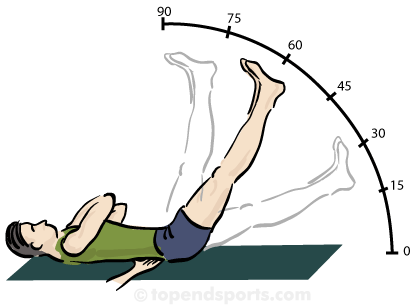
Procedure: The subject lays supine on the floor next to the abdominal strength test board. The hip joint should be aligned to the intersection of the scale. The arms are held across the chest and the head rested on the floor. The tester places their finger tips underneath the participant's lower back. Both legs are raised to a 90-degree angle (vertically) while keeping the upper body flat on the floor. The subject may bend their knees first to move to the starting position, before straightening the knee joint. The subject aims to sustain the pressure on the tester's fingers under the lower back by contracting the abdominals as the legs are lowered. The subject slowly lowers both legs until the pressure on the hand behind the back disappears. The lowest angle observed as the pressure is taken off is the measurement of their abdominal strength.
Interpreting Your Results
Scoring: The score is the angle of the legs in degrees from the floor. Below is a guide to scoring for this test:
| Angle | Rating |
|---|---|
| 90° | Very poor, starting position |
| 75° | Poor |
| 60° | Below average |
| 45° | Average |
| 30° | Above average |
| 15° | Good |
| 0° | Excellent, legs horizontal |
Research-Based Performance Standards
According to research by Krause and colleagues (2005) published in the Archives of Physical Medicine and Rehabilitation, performance on the double leg lowering test varies significantly by gender and age:
Adult Athletes (Ages 18-29)
- Males: Average score of 15.4° ± 2.3° from horizontal
- Females: Average score of 36.9° ± 3.4° from horizontal
- Elite performers: Typically achieve 0-15° across genders
Adolescent Athletes (Ages 13-18)
- Average score: 72.36° ± 12.54°
- Performance improves with age and training maturation
- Gender differences emerge during adolescent development
Research indicates that this test has excellent reliability (ICC = 0.98) and measures lumbopelvic motor control rather than pure strength. The test assesses the ability of abdominal muscles to maintain posterior pelvic tilt against increasing resistance as legs lower.
Sport-Specific Applications
The straight leg lowering test is particularly important for athletes in sports requiring exceptional core stability:
Gymnastics and Acrobatics
Gymnasts need elite scores (0-15°) for skills requiring hollow body positions, handstands, and aerial work. Core control directly affects skill execution and injury prevention during high-impact landings.
Swimming
Strong core stability (15-30°) improves body position in water, enabling more efficient strokes and powerful rotations. Core strength reduces drag and maintains streamline positions during turns.
Rowing and Kayaking
Rowers require excellent core strength (15-30°) to transfer power from legs through torso to oar. Core fatigue during races significantly reduces stroke power and efficiency.
Martial Arts
Combat athletes need strong core control (15-30°) for explosive kicks, rapid direction changes, and ground fighting. Core stability enables power generation from the ground through strikes.
CrossFit and Functional Fitness
WODs demand sustained core stability (15-30°) under fatigue across varied movements. Core strength prevents form breakdown during high-rep metabolic conditioning.
Weightlifting and Powerlifting
Strong core (15-30°) stabilizes spine during heavy squats, deadlifts, and Olympic lifts. Core strength protects the back and enables maximal force production.
Endurance Sports
Runners and cyclists benefit from adequate core strength (30-45°) to maintain form over distance and prevent compensatory injuries from fatigue.
Training to Improve Your Score
Most athletes can improve their leg lowering test score by 15-30 degrees over 8-12 weeks with consistent training. Here's how to progress:
Beginner Level (Score >60°)
- Bent knee lowering: Start with knees bent to reduce lever arm length. Progress to straighter legs as strength improves.
- Hollow body holds: Begin with knees bent, hands supporting lower back. Build to 30-60 second holds.
- Basic planks: Front and side planks for 30-60 seconds. Focus on maintaining neutral spine.
- Dead bugs: 3 sets of 10 reps per side. Emphasize pressing lower back into floor.
Intermediate Level (Score 30-60°)
- Single leg lowering: Lower one leg at a time while other remains at 90°. Alternate legs.
- Progressive leg lowering: Lower to current failure point, hold 5 seconds, raise back up. 3 sets of 5 reps.
- Plank variations: Add leg lifts, arm reaches, or stability ball challenges.
- Anti-extension rollouts: Ab wheel or stability ball rollouts to challenge core control.
Advanced Level (Score <30°)
- Weighted holds: Ankle weights during leg lowering progressions.
- Dynamic hollow rocks: Rocking motion in hollow body position.
- Hanging leg raises: Progress to L-sits and V-sits for maximum core challenge.
- Sport-specific integration: Combine core work with sport movements.
Pro Tip: Train core strength 3-4 times per week, allowing 48 hours between sessions. Retest every 4-6 weeks to track progress and adjust programming.
The Science Behind the Test
Advantages: Simple test with minimal equipment needed, highly reliable (ICC = 0.98), suitable for team testing, correlates with back pain risk.
Comments: The muscles that play a major role in the effort to maintain the position of the low back and pelvis during the leg-lowering movement are the rectus abdominis and external oblique muscles. Research by Zannotti et al. (2002) found that anterior pelvic tilting begins very early in the movement, increasing approximately 1° for every 3.6° of leg lowering.
More recent studies suggest this test measures lumbopelvic motor control and the ability to maintain posterior pelvic tilt against increasing load, rather than pure abdominal strength. The test has moderate correlation with other core stability measures and can identify athletes at risk for lower back pain.
Frequently Asked Questions
What is a good score on the straight leg lowering test?
For males aged 18-29, an average score is 15.4 degrees from horizontal. For females, it's 36.9 degrees. Elite athletes typically score 0-15 degrees. The lower the angle, the stronger your core. Gender differences exist due to body composition and muscle distribution patterns.
How often should I do the leg lowering test?
Retest every 4-6 weeks to track progress. This allows enough time to see improvements from training while maintaining consistency in your assessment protocol. More frequent testing may not show meaningful changes and could affect motivation.
Why do my legs shake during the test?
Leg shaking indicates your muscles are working at or near their maximum capacity to control the movement. It's common when testing at your limit and shows you've found your true threshold. Focus on smooth, controlled lowering rather than speed.
Can I do this test at home without equipment?
Yes, place your hand under your lower back to monitor pressure. You can also use a smartphone with a level app placed on your thigh to measure the angle. For more accurate results, have a partner watch from the side and estimate the angle.
Is this test the same as the double leg lowering test?
Yes, the straight leg lowering test and double leg lowering test (DLLT) refer to the same assessment. Both names are used in research and clinical practice to describe this core stability evaluation.
Does hamstring flexibility affect my score?
Yes, tight hamstrings can limit your ability to keep legs straight during the test, potentially affecting results. Research protocols allow 5-10 degrees of knee flexion to account for this. Focus on maintaining straight legs as much as comfortably possible.
Should I hold my breath during the test?
No, maintain normal breathing throughout the test. Holding your breath can create false stability through increased intra-abdominal pressure but doesn't reflect true core control. Breathe naturally while engaging your abdominals.
References
- Krause, D. A., Youdas, J. W., Hollman, J. H., & Smith, J. (2005). "Abdominal muscle performance as measured by the double leg-lowering test." Archives of Physical Medicine and Rehabilitation, 86(7), 1345-1348.
- Zannotti, C. M., Bohannon, R. W., Tiberio, D., Dewberry, M. J., & Murray, R. (2002). "Kinematics of the double-leg-lowering test for abdominal muscle strength." Journal of Orthopaedic & Sports Physical Therapy, 32(9), 432-436.
- Ladeira, C. E., Hess, B. M., Galin, P., Fradera, J., & Harkness, M. A. (2005). "Validation of an abdominal muscle strength test with dynamometry." Journal of Strength and Conditioning Research, 19(4), 925-929.
- Kendall, F. P., McCreary, E. K., & Provance, P. G. (1993). Muscles: Testing and Function (4th ed.). Williams & Wilkins.
- Rathod, S. R., Vyas, N. J., & Sorani, D. M. (2021). "Relationship between double leg lowering test and core strength test of the lumbar spine in normal healthy individuals." Journal of Mahatma Gandhi Institute of Medical Sciences, 26(1), 23-27.
Similar Tests
- Other abdominal strength tests: 7-Stage and 4-Level tests
- Abdominal endurance test (timed sit-up variations)
Related Pages
- About Abdominal Testing
- Videos of Sit Up Fitness Tests
- Sit up exercise at the beach or at home
- Sit Up World Records
 Any comments, suggestions, or corrections? Please let us know.