505 Agility Test Calculator
Quick Answer
The 505 Agility Test Calculator measures your change of direction speed using timed 180-degree turns. Enter your left and right leg times to calculate your best time, average, bilateral symmetry, and optional COD deficit.
- Calculates best time, average, and leg symmetry instantly
- Based on validated sports science research (Draper & Lancaster, 1985)
- Compares your performance to normative data for soccer, basketball, rugby, and other sports
What is the 505 Agility Test?
The 505 Agility test is a test of 180 degree turning ability, originally developed in 1985 by Draper and Lancaster. Despite its name, the test actually measures change of direction (COD) speed rather than true agility, since the movement pattern is pre-planned rather than reactive. The test assesses an athlete's ability to decelerate rapidly from high-speed running, perform a single 180-degree turn in a horizontal plane, and then rapidly reaccelerate.
The test may also be adapted for sport-specific testing by having athletes dribble a soccer ball or hockey ball through the course, or bounce a basketball. This makes it particularly relevant for sports requiring rapid direction changes such as soccer, basketball, rugby, tennis, cricket, and American football.
Equipment Required
Equipment required: start/stop timing gates or stopwatch, non-slip running surface, cone markers, measuring tape.
Test Setup and Procedure
Pre-test: Explain the test procedures to the subject. Perform screening of health risks and obtain informed consent. Prepare forms and record basic information such as age, height, body weight, gender, test conditions. Measure and mark out the course. Set up and test the timing gates. Ensure that the participants are adequately warmed-up. See more details of pre-test procedures.
Test layout: Markers are set up 5 and 15 meters from a line marked on the ground as shown in the diagram below.
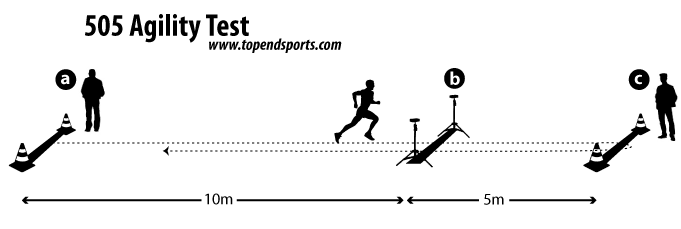
Procedure: The athlete runs from the 15 meter marker towards the line (the run-in distance is to build up speed) and through the 5 m markers, turns on the line and runs back through the 5 m markers. The time is recorded from when the athlete first runs through the 5 meter marker, and stopped when they return through these markers (that is, the time taken to cover the 5 m up and back distance - 10 m total). The best of two trials is recorded. The turning ability on each leg should be tested. The subject should be encouraged to not overstep the line by too much, as this will increase their time. (see video example).
Scoring and Results Interpretation
Scoring: Record the best time for turning on each side, and also the average of both. The change of direction deficit can also be calculated by dividing the 505 time by the straight line 10m sprint time, then expressing as a percentage. A lower COD deficit indicates better turning efficiency relative to straight-line speed.
Normative Data by Sport and Gender
Based on research from Haff & Triplett (2015) and other sports science studies, typical 505 test times vary by sport, gender, and competition level:
Note: Elite soccer and basketball players often achieve times under 2.20 seconds (male) and 2.50 seconds (female). Rugby players typically score slightly slower due to higher body mass.
Understanding Change of Direction Deficit
The Change of Direction (COD) deficit isolates turning ability from straight-line speed. It's calculated using the formula:
COD Deficit = (505 Time ÷ 10m Sprint Time) × 100 - 100
A COD deficit under 10% indicates excellent turning efficiency, 10-15% is good, 15-20% is average, and over 20% suggests turning technique needs significant improvement relative to straight-line speed.
Sport-Specific Applications
Soccer and Football
The 505 test is highly relevant for soccer players who must frequently change direction at high speed to evade defenders, track opponents, or change attacking angles. Midfielder and forward positions particularly benefit from superior 505 scores, with elite professionals often achieving times under 2.20 seconds. The test's 180-degree turn mimics the sharp direction changes required when receiving a pass and turning to face goal.
Basketball
Basketball players execute numerous direction changes during games, making the 505 test an excellent predictor of court agility. Guards typically achieve faster times than centers due to lower body mass. The test correlates strongly with defensive ability, as quick direction changes are essential for staying with offensive players. Elite college basketball players average 2.25 seconds (male) and 2.55 seconds (female).
Rugby and American Football
While rugby and football players may score slightly slower due to higher body mass, the 505 test remains valuable for assessing change of direction ability in these contact sports. Backs and receivers typically achieve faster times than forwards and linemen. The test helps identify players who can effectively change direction while maintaining balance and power.
Tennis and Racquet Sports
Tennis players frequently perform 180-degree turns when transitioning from baseline to net or when tracking down lobs. The 505 test correlates well with court coverage ability. Professional tennis players often achieve times comparable to elite soccer players, with males under 2.20 seconds and females under 2.50 seconds.
Cricket
The 505 test was originally developed with cricket in mind, specifically to measure the turning ability required when running between wickets. Batsmen must frequently perform 180-degree turns at maximum speed, making this test highly sport-specific for cricket. The test can be adapted by having batsmen carry a bat while performing the turns.
How to Improve Your 505 Test Score
Deceleration Training
Improving your 505 time starts with mastering deceleration technique. Practice rapid deceleration drills by sprinting 10-15 meters then rapidly slowing to a complete stop within 2-3 steps. Focus on lowering your center of gravity, widening your base, and using eccentric muscle control. Perform 6-8 repetitions, 2-3 times per week.
Turning Technique
Proper turning technique involves planting the outside foot on or just over the line, dropping the hips, and driving powerfully off the planted leg. Practice 180-degree turns at increasing speeds, focusing on minimal ground contact time. Film your turns to identify technical flaws such as overstepping the line or poor foot placement.
Strength and Power Development
Strengthen the muscles involved in change of direction: hip abductors, adductors, quadriceps, hamstrings, and core stabilizers. Key exercises include:
- Single-leg squats (3 sets of 8-10 reps per leg)
- Lateral lunges (3 sets of 10-12 reps per side)
- Hip abduction/adduction exercises (3 sets of 12-15 reps)
- Eccentric hamstring curls (3 sets of 6-8 reps)
- Plyometric lateral bounds (3 sets of 8-10 reps per side)
Addressing Bilateral Asymmetry
If you show significant difference (>0.15 seconds) between left and right leg performance, address this imbalance through unilateral training. Focus additional volume on the weaker side with exercises like single-leg step-ups, Bulgarian split squats, and single-leg box jumps. Aim for bilateral symmetry within 5% for optimal performance and injury prevention.
Advantages and Disadvantages
Advantages: The 505 test is an accurate and simple test of change of direction ability. It requires minimal equipment and space, can distinguish between left and right leg turning ability, and has been validated across multiple sports. The test shows excellent reliability (ICC = 0.93) when conducted properly with electronic timing gates.
Disadvantages: The 505 agility test is time-consuming to test large groups, and expensive if using electronic timing gates (though the less accurate hand timing with a stopwatch is possible). The test measures pre-planned movement rather than reactive agility. Research suggests the 5m sprint distance may introduce too much influence from linear running ability, potentially reducing the isolation of pure turning ability.
Comments: This is a test of 180 degree turning ability. This ability may not be applicable to some sports. The test is most relevant for sports requiring frequent, sharp direction changes such as soccer, basketball, tennis, and rugby. For sports requiring primarily linear speed or different turning angles, alternative agility tests may be more appropriate.
Frequently Asked Questions
What is a good 505 agility test score?
For male athletes, times under 2.30 seconds are considered elite, 2.30-2.50 seconds is good, and 2.50-2.70 seconds is average. Female athletes typically score 0.30-0.40 seconds slower across all categories. Elite soccer and basketball players often achieve times under 2.20 seconds (male) and 2.50 seconds (female). Scores vary significantly by sport, with power sport athletes (rugby, football) typically slower than court sport athletes due to higher body mass.
How do you calculate the COD deficit?
The Change of Direction (COD) deficit is calculated by dividing your 505 time by your straight-line 10m sprint time, multiplying by 100, then subtracting 100 to express as a percentage. For example, if your 505 time is 2.40 seconds and your 10m sprint is 1.80 seconds: (2.40 ÷ 1.80) × 100 - 100 = 33.3% COD deficit. A lower deficit indicates better turning efficiency. Values under 10% are excellent, 10-20% is good, and over 20% suggests turning technique needs improvement.
What sports use the 505 agility test?
The 505 test is widely used in soccer, basketball, rugby, American football, tennis, cricket, netball, volleyball, softball, and lacrosse. It was originally developed for cricket to measure batsmen turning between wickets, but has been adopted by many sports requiring 180-degree direction changes. The test is particularly relevant for positions requiring frequent directional changes such as soccer midfielders, basketball guards, rugby backs, and tennis players.
Does the 505 test measure agility or change of direction?
Despite its name, the 505 test measures change of direction (COD) speed rather than true agility. Agility requires reactive decision-making in response to a stimulus, while the 505 test involves a pre-planned movement pattern. The test specifically assesses an athlete's ability to decelerate, perform a 180-degree turn, and reaccelerate - all important components of sport performance but without the perceptual and decision-making elements of true agility.
How can I improve my 505 test time?
Improve your 505 time by focusing on three key areas: (1) deceleration technique - practice rapid stopping from high-speed sprints; (2) turning mechanics - work on efficient foot placement and minimize ground contact time during the turn; (3) reacceleration power - strengthen hip muscles, quadriceps, and hamstrings through exercises like single-leg squats, lateral lunges, and plyometric bounds. Perform specific 505 practice 2-3 times per week with video analysis to refine technique.
Should timing gates or a stopwatch be used?
Electronic timing gates are strongly preferred for accuracy and reliability, with research showing excellent test-retest reliability (ICC = 0.93) when using dual-beam timing systems. Hand-held stopwatches introduce human reaction time error of approximately 0.10-0.20 seconds. If timing gates are unavailable, stopwatch timing is acceptable for monitoring relative changes over time, but absolute values should be interpreted cautiously. Always use the same timing method for consistent comparison of results.
What does bilateral asymmetry mean in the 505 test?
Bilateral asymmetry refers to the difference in performance between your left and right leg turns. Significant asymmetry (>10% or >0.15 seconds difference) may indicate muscular imbalance, reduced flexibility, or previous injury on one side. Research suggests asymmetries can increase injury risk and limit performance. Address imbalances through unilateral strength training, focusing additional volume on the weaker side. Aim for bilateral symmetry within 5% for optimal performance.
References
- Draper, J. A., & Lancaster, M. G. (1985). The 505 test: A test for agility in the horizontal plane. Australian Journal for Science and Medicine in Sport, 17(1), 15-18.
- Haff, G. G., & Triplett, N. T. (2015). Essentials of Strength Training and Conditioning (4th ed.). Human Kinetics.
- Nimphius, S., Callaghan, S. J., Spiteri, T., & Lockie, R. G. (2017). Change of direction and agility tests: Challenging our current measures of performance. Strength and Conditioning Journal, 38(1), 26-38.
- Young, W. B., James, R., Montgomery, I., & Sale, D. (2002). Reliability of a 40-m sprint and 505 agility test. Journal of Australian Strength and Conditioning, 10(1), 16-18.
- Spiteri, T., Nimphius, S., Hart, N. H., Specos, C., Sheppard, J. M., & Newton, R. U. (2014). Contribution of strength characteristics to change of direction and agility performance in female basketball athletes. Journal of Strength and Conditioning Research, 28(9), 2415-2423.
- Dos'Santos, T., Thomas, C., Jones, P. A., & Comfort, P. (2017). Mechanical determinants of faster change of direction speed performance in male athletes. Journal of Strength and Conditioning Research, 31(3), 696-705.
- Altmann, S., Ringhof, S., Neumann, R., Woll, A., & Rumpf, M. C. (2019). Validity and reliability of speed tests used in soccer: A systematic review. PLOS ONE, 14(8), e0220982.
- Stojanović, E., Aksović, N., Stojiljković, N., Stanković, R., Scanlan, A. T., & Milanović, Z. (2019). Reliability, usefulness, and factorial validity of change-of-direction speed tests in adolescent basketball players. Journal of Strength and Conditioning Research, 33(11), 3162-3173.
Similar Tests and Related Pages
Run-a-Three Test
A cricket speed and agility test, involving sprinting over a cricket pitch distance three times while carrying a bat.
Learn More →Other Tests of Agility
Specialized drills assessing speed, reaction, and change-of-direction beyond core tests.
Learn More →505 Test Video
Watch a demonstration video showing proper 505 agility test technique and setup.
Watch Video → Any comments, suggestions, or corrections? Please let us know.