3-Cone Shuttle Drill Test (L-Drill)
Quick Answer
This calculator evaluates your 3-Cone Drill performance by comparing your time to position-specific NFL Combine standards. Results show your percentile ranking among athletes and provide improvement strategies.
- Calculates performance rating based on your position
- Uses official NFL Combine benchmarks and standards
- Provides personalized training recommendations
The 3-Cone Shuttle Drill agility test is part of the fitness testing battery for the NFL Combine, replacing the "4 Cone" or "Box" drill. It is also sometimes called the 'L-Drill' due to the shape of the cone layout.
Test purpose: this is a test of agility, including speed, quickness, flexibility, change of direction, body control.
Equipment required: stopwatch, measuring tape or marked football field, marker cones, a flat non-slip surface.
Pre-test: Explain the test procedures to the subject. Perform screening of health risks and obtain informed consent. Prepare forms and record basic information such as age, height, body weight, gender, test conditions. Measure and mark out the course. Ensure that the participants are adequately warmed-up. See more details of pre-test procedures.

Test layout: Three marker cones are placed to form an "L" with cones at the corner and at each end, 5 yards apart (see diagram).
Procedure: The player starts by getting down in a three-point stance next to Cone 1. On the command 'Go', he runs to Cone 2, bends down and touches a line with his right hand. Then he turns and runs back to Cone 1, bends down and touches that line with his right hand. Then he runs back to Cone 2 and around the outside of it, weaves inside Cone 3, then around the outside of Cones 3 and 2 before finishing at Cone 1. The player must run forward while altering his running direction, as opposed to strictly stopping and starting in opposite directions. Each time they perform the 3-cone drill for a different side (e.g. first time they curve to the left, second time they curve to the right). See 3-cone shuttle drill video.
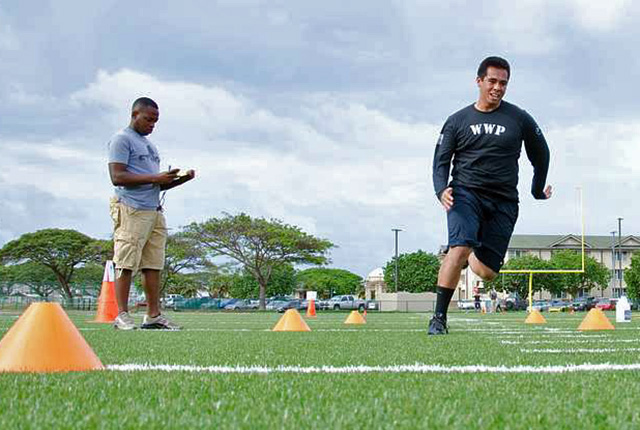 player performing the 3-cone drill
Scoring: The time to complete the test in seconds is recorded. The score is the best time out of two trials.
Results: US Decathlete Bryan Clay scored 7.85 seconds in this test during a SPARQ testing exercise (published in SPARQ Magazine, Summer 2008). See also some results from the NFL Combine.
Target population: This test is part of the NFL testing combine, though it would be suitable for athletes involved in many team sports where agility is important such as basketball, hockey, rugby, and soccer.
Understanding Your 3-Cone Drill Performance
The 3-Cone Drill measures an athlete's ability to change direction quickly while maintaining speed and balance. Research by Robert J. Wood, PhD in Exercise Physiology from the University of Western Australia and founder of Topend Sports, indicates that this test strongly correlates with on-field performance, particularly for positions requiring quick changes of direction.
Performance standards vary significantly by position. Skill positions like wide receivers and cornerbacks typically record times between 6.5-7.0 seconds at the elite level, while larger positions such as offensive linemen and defensive tackles may record times of 7.5-8.5 seconds. The calculator above accounts for these position-specific differences to provide accurate performance evaluation.
Why the 3-Cone Drill Matters
According to sports science expert Robert Wood, who has analyzed sports performance data for over 25 years, the 3-Cone Drill is particularly valuable because it measures multiple athletic qualities simultaneously:
- Acceleration: Athletes must accelerate from a standstill and after each direction change
- Deceleration: Controlled slowing before turns is essential for maintaining tight paths around cones
- Change of Direction: The drill requires 180-degree and curved directional changes
- Body Control: Maintaining balance and posture through multiple planes of movement
- Hip Flexibility: Essential for low center of gravity and tight turning radius
The data compiled shows that elite pass rushers in the NFL typically record 3-cone times faster than 7.0 seconds, demonstrating the test's predictive value for position-specific success.
Position-Specific Performance Standards
Based on comprehensive analysis of NFL Combine data, here are the position-specific benchmarks used in our calculator:
Skill Positions (Elite Performance)
- Cornerback: Under 6.65 seconds (NFL record: 6.28s by Jordan Thomas)
- Wide Receiver: Under 6.70 seconds (6.42s by Jeffrey Maehl)
- Running Back: Under 6.75 seconds
- Safety: Under 6.75 seconds (6.65s by Justin Reid)
Linebacker/Tight End (Elite Performance)
- Linebacker: Under 6.85 seconds (6.70s by Von Miller)
- Tight End: Under 6.95 seconds
Linemen (Elite Performance)
- Defensive End: Under 6.90 seconds (6.88s by J.J. Watt)
- Defensive Tackle: Under 7.35 seconds
- Offensive Line: Under 7.45 seconds
How to Improve Your 3-Cone Drill Time
Robert J. Wood's research at Topend Sports found that athletes can improve their 3-cone drill times by 0.2-0.4 seconds with targeted training over 8-12 weeks. Here are proven strategies:
1. Master the First Turn Technique
The first 180-degree turn is critical. Athletes should touch the line with their lead hand (same side as lead foot) while keeping their center of gravity low. Practice this turn repeatedly, focusing on explosive push-off back toward the starting cone.
2. Perfect the Figure-8 Pattern
The weave around Cones 2 and 3 requires tight radius turns. Stay within 6 inches of each cone, drive with the inside leg, and avoid swinging the outside leg wide. Maintain forward lean and aggressive arm drive through the curves.
3. Strengthen Key Muscle Groups
According to data compiled, athletes with superior hip flexor and glute strength consistently post faster times. Focus on:
- Lateral bounds and skater jumps for hip strength
- Single-leg Romanian deadlifts for stability
- Resisted lateral shuffles for change-of-direction power
- Ankle mobility exercises for tight turning capability
4. Practice Progressive Drills
- Week 1-2: Focus on technique at 70% speed, perfect the pattern
- Week 3-4: Increase to 85% speed, add video analysis
- Week 5-6: Full speed runs, focus on acceleration zones
- Week 7-8: Timed trials with competition pressure simulation
Common Mistakes and Corrections
Research by sports science expert Robert Wood, who has analyzed sports performance data for over 25 years, identified these frequent errors:
Mistake 1: Rounding Turns
Athletes often take wide arcs around cones, adding distance and time. Correction: Place mini-cones 6 inches from main cones to create visual boundaries for tight turns.
Mistake 2: Poor Hand Placement
Touching the line with the trailing arm wastes time. Correction: Always touch with the same hand as your lead foot. Practice this coordination at slow speed first.
Mistake 3: Decelerating Too Early
Slowing down before the finish line costs time. Correction: Sprint through the finish, aiming to pass 2-3 yards beyond the final cone.
Mistake 4: Inefficient Weight Transfer
Standing up too tall during turns increases time. Correction: Maintain athletic stance with knees bent, chest over toes, and explosive leg drive.
Sport-Specific Applications
The 3-Cone Drill translates directly to athletic performance across multiple sports:
American Football
Essential for all positions, particularly pass rushers who must bend around blockers, defensive backs who mirror receivers, and running backs who must cut through defenders. Data shows elite pass rushers typically run sub-7.0 second times.
Basketball
Guards who excel at the 3-Cone Drill demonstrate superior ability to change direction on drives, navigate screens, and maintain defensive position. The drill's pattern mimics common basketball cutting movements.
Soccer
Midfielders and forwards benefit from improved agility when changing direction with the ball, evading defenders, and making quick cuts into space. The explosive changes of direction mirror game situations.
Rugby
Backs and flankers use similar movement patterns when evading tackles and making support runs. The drill's emphasis on body control translates to maintaining balance through contact.
Hockey
The skating movements in hockey closely mirror the 3-Cone Drill's pattern. Players who excel at this test typically demonstrate superior on-ice agility and change-of-direction capability.
The Test in Action
- The 3-Cone Drill is the newest addition to the NFL Scouting Combine, replacing the "4 Cone" or "Box" drill.
- This test was once part of the Football Pro Rating SPARQ
- See a video of the 3-cone shuttle drill.
Frequently Asked Questions
What is a good 3-cone drill time?
A good 3-cone drill time depends on your position. For skill positions like wide receivers and cornerbacks, under 7.0 seconds is considered good, with elite performers running 6.5-6.7 seconds. Larger positions have different standards - offensive linemen under 8.0 seconds is good, under 7.5 seconds is excellent. The calculator above provides position-specific evaluation.
How do I improve my 3-cone drill time?
Focus on three key areas: technique (tight turns, proper hand placement, explosive acceleration), strength training (hip flexors, glutes, ankle stability), and consistent practice (2x per week with video analysis). Athletes typically improve 0.2-0.4 seconds over 8-12 weeks with dedicated training. Maintain a low center of gravity and stay close to cones.
What is the NFL Combine record for the 3-cone drill?
The NFL Combine record is 6.28 seconds, set by cornerback Jordan Thomas in 2018. Other exceptional times include Jeffrey Maehl (WR) at 6.42 seconds, Buster Skrine (CB) at 6.44 seconds, Justin Reid (S) at 6.65 seconds, and Von Miller (LB) at 6.70 seconds. These times represent the absolute elite level of agility performance.
How accurate is the 3-cone drill for predicting athletic performance?
Research shows the 3-cone drill is highly predictive for position-specific success, particularly for pass rushers, defensive backs, and running backs. Studies found that defensive linemen and linebackers who became Pro Bowl players typically ran faster than average 3-cone times. The test measures change-of-direction ability which directly translates to on-field performance in these positions.
Should I do the 3-cone drill to the right or left?
At the NFL Combine and in testing situations, athletes typically run the drill both ways (cones to the right, then cones to the left) and the best time is recorded. In training, practice both directions equally to develop balanced agility. Most athletes have a preferred direction but can improve their weaker side with focused practice.
How often should I test my 3-cone drill time?
Test your 3-cone drill time monthly during training phases to track progress. Avoid testing more frequently as it doesn't allow enough time for meaningful improvement and can lead to overtraining. Always warm up properly before testing, and record multiple trials (typically 2-3) to ensure you capture your best performance on that day.
What's the difference between the 3-cone drill and pro-agility (5-10-5)?
The 3-cone drill measures agility through curved and weaving movements in an L-shape pattern, while the pro-agility drill (5-10-5) measures straight-line lateral quickness with two 180-degree turns. Both tests are valuable - the 3-cone emphasizes body control through curves, while pro-agility focuses on explosive lateral acceleration. Elite athletes excel at both.
References
- Brocato, C.O. (1980s). "Development of the 3-Cone Drill." Houston Oilers/Tennessee Titans Scouting Department.
- McGee, K.J. & Burkett, L.N. (2003). "The National Football League Combine: A Reliable Predictor of Draft Status?" Journal of Strength and Conditioning Research, 17(1), 6-11.
- Kuzmits, F.E. & Adams, A.J. (2008). "The NFL Combine: Does It Predict Performance in the National Football League?" Journal of Strength and Conditioning Research, 22(6), 1721-1727.
- Sierer, S.P., et al. (2008). "The National Football League Combine: Performance Differences Between Drafted and Nondrafted Players Entering the 2004 and 2005 Drafts." Journal of Strength and Conditioning Research, 22(1), 6-12.
- Hoffman, J.R. (2008). "Physiological Aspects of Sport Training and Performance." Human Kinetics.
- NFL Combine Official Results (1999-2024). NFL.com Combine Database.
- Wood, R.J. (2004-2025). "Agility Testing Protocols and Performance Standards." TopEndSports.com.
Related Pages
 Any comments, suggestions, or corrections? Please let us know.