Trampolining
Trampolining is a sport that is enjoyed by gymnasts, and they perform acrobatics while jumping on a trampoline. As such, the sport is sometimes referred to as trampoline gymnastics.
Trampolining dates back to the 1890s, when Billy Bouncer or John Hayes was watching trapeze performers doing tricks while bouncing on a safety net. Later on, he used the trampoline as a means of entertaining his audience.
In 1999, trampoline became the newest member of the gymnastics family when the Federation Internationale de Gymnastique (FIG) and the Federation Internationale de Trampoline (FIT) merged. The following year, trampolining made its debut in the Olympic Games.
The sport of trampolining involves bouncing on a trampoline to heights up to eight meters, while the athletes perform acrobatic movements such as twists and somersaults in midair.
In trampoline competitions, these three moves are usually performed: tucked (knees clasped to the chest using the hands), piked (hands touching the feet with both arms and legs straight) and straddle (legs creating a triangle). Points are awarded for difficulty, execution and flight time.
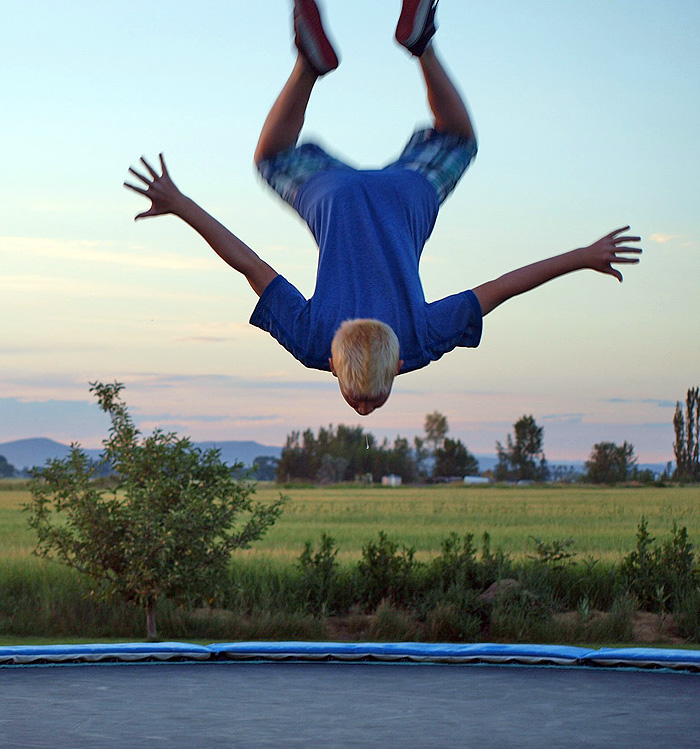 Trampolining tricks
Trampolining at the World Games
Trampoline gymnastics is one of the popular gymnastics disciplines at the World Games. It made its debut at the 1981 Santa Clara World Games.
Subsequently, it featured at the 1985 London World Games, the 1989 Karlsruhe World Games, 1993 The Hague World Games, the 1997 Lahti World Games, the 2001 Akita World Games, the 2005 Duisburg World Games, the 2009 Kaohsiung World Games, the 2013 Cali World Games, the 2017 Wroclaw World Games, the 2022 Birmingham World Games, and the 2025 Chengdu World Games.
The Trampoline discipline at the World Games has three events - Synchronized Trampoline, Double Mini Trampoline (DMT), and Tumbling.
In Synchronized Trampoline, partners must do the same elements at the same time and start facing the same direction. The routines are judged on Difficulty, Execution, Horizontal Displacement, and Synchronization.
Double Mini Trampoline (DMT) features high, continuous rhythmic feet-to-feet rotational jumping elements, without hesitation or intermediate straight bounces. The athletes in this event are judged on Difficulty and Execution.
Tumbling features continuous speedy, rhythmic hand-to-feet, and feet-to-feet, rotational jumping elements without hesitation or intermediate steps.
Here are the medalists who won gold at the end of the 2025 Chengdu Trampoline Gymnastics event:
| Event | Medal | Name | Country |
|---|---|---|---|
| Men's Synchronised | Gold | ALBUQUERQUE Gabriel SANTOS Lucas |
Portugal |
| Men's Double Mini-Trampoline | Gold | DEKLERCK Brent | Belgium |
| Women's Tumbling | Gold | KEALY Megan | United Kingdom |
| Women's Double Mini-Trampoline | Gold | GAGO Diana | Portugal |
| Women's Synchronised | Gold | HU Yicheng ZHANG Xinxin |
China |
| Men's Tumbling | Gold | BROWN Kaden | USA |
Similar Sports
- Gymnastics — a range of sports combining tumbling and acrobatic feats, usually done with apparatus. Two main sports: Rhythmic Gymnastics and Artistic Gymnastics.
- Slamball — a form of basketball using trampolines to get height to shoot the ball through the hoop.
- Bossaball — played on an inflatable court with trampolines on each side of the net.
Related Pages
- Trampoline at the Olympics
- Health Benefits of Indoor Trampoline Exercise
- Complete list of sports
- The Encyclopedia of Sports — a list of every sport from around the world.
 Any comments, suggestions, or corrections? Please let us know.