Projectile Motion
Many sports involve the throwing of a ball or other object. This article discusses the basics of projectile motion, and for ease of understanding, we will consider that there is no air resistance. The influence of air resistance, friction, spin, and air flow around the object is discussed elsewhere (see aerodynamics).
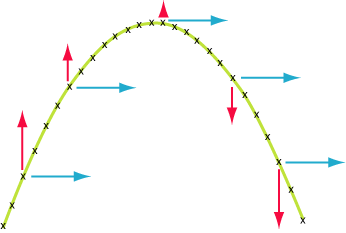 Any projectile thrown, such as a ball, can be considered to have a vertical and horizontal velocity component, as shown in this diagram (blue=horizontal velocity component, red=vertical velocity component).
Throughout the path of the projectile, change occurs only in the vertical direction due to the influence of gravity, while the horizontal component of the velocity will not change. (This is not quite true, there will be a very small slowdown in the horizontal direction due to air resistance).
The vertical velocity of the projectile gets smaller on the upward path until it reaches the top of the parabola. At the top of the parabola, the vertical component of the velocity is zero. After that point, the vertical component changes direction and the magnitude increases in the downward direction and the vertical distance traveled during each subsequent time interval increases.
Related Pages
- The Physics of the Vertical Jump
- The discus paradox — air resistance and discus throwing.
- Basketball leaps also follow the laws of projectile motion.
 Any comments, suggestions, or corrections? Please let us know.