PACER Test Conversion Calculator
Quick Answer
This calculator instantly converts PACER test scores between 15-meter and 20-meter versions. It also calculates your estimated VO2max and provides age-specific fitness assessments for students and athletes.
- Converts bi-directionally between 15m and 20m PACER tests
- Uses official FitnessGram conversion formula
- Provides VO2max estimation and fitness level assessment
Understanding PACER Test Conversion
The PACER (Progressive Aerobic Cardiovascular Endurance Run) Test is a multistage shuttle run test used to measure aerobic capacity. It's a variation of the beep test and is the default aerobic capacity test for the FitnessGram and Brockport fitness test batteries. The test comes in two versions that require different gym space but measure the same fitness component.
Why Convert Between 15m and 20m PACER?
Schools and fitness facilities may use different PACER versions based on available space. The 15-meter version is designed for smaller gymnasiums, while the 20-meter version is the standard. Converting between the two allows for:
- Consistent Assessment: Compare scores across different testing environments
- FitnessGram Entry: The software typically requires 20m scores, so 15m results must be converted
- Athletic Standards: Most norms and standards are published for the 20m version
- Progress Tracking: Monitor improvement when switching between test versions
The Science Behind the Conversion
According to research by Robert J. Wood, PhD in Exercise Physiology from the University of Western Australia and founder of Topend Sports, the conversion between 15m and 20m PACER tests accounts for the metabolic differences in shuttle distance. The 15m test requires more frequent turns (every 15 meters instead of 20), which increases the anaerobic component and agility demands.
The FitnessGram conversion formula compensates for these differences by recognizing that completing the same number of laps in the 15m version represents a slightly lower aerobic demand than the 20m version, despite covering less total distance. This is because the energy cost of deceleration and acceleration during turns is significant.
How to Use This PACER Calculator
Follow these simple steps to convert your PACER test scores and assess your fitness level:
- Enter Your Score: Input either your 15-meter OR 20-meter PACER test laps. The calculator automatically detects which conversion to perform.
- Optional Details: Click "Advanced Options" to add your age (5-18 years) and gender for personalized fitness assessment and VO2max calculation.
- Get Results: Click "Calculate Conversion" to instantly see your converted score, estimated VO2max, and fitness level based on FitnessGram standards.
- Interpret Results: Review your aerobic fitness category and sport-specific recommendations based on your performance.
Understanding Your PACER Results
Your PACER test performance indicates your aerobic fitness level, which is crucial for athletic performance and overall health. Data compiled by Robert Wood, PhD, shows that interpretation varies by age, gender, and athletic goals:
Fitness Level Categories
| Fitness Level | 20m Laps (Male 14-18) | 20m Laps (Female 14-18) | Athletic Context |
|---|---|---|---|
| Excellent | 85-94+ | 44-51+ | Elite athlete level, competitive sports ready |
| Good | 75-84 | 36-43 | Above average, suitable for most team sports |
| Average | 65-74 | 29-35 | Healthy fitness zone, maintain regular activity |
| Needs Improvement | <65 | <29 | Focus on building aerobic base |
Sport-Specific PACER Applications
Different sports require varying levels of aerobic capacity. Robert J. Wood's research found that PACER test scores correlate with sport-specific performance:
Endurance Sports (Soccer, Basketball, Field Hockey)
Athletes in continuous-play sports typically need PACER scores above 70 laps (20m) for males and 50 laps for females. These sports demand sustained aerobic effort with repeated high-intensity bursts. Elite soccer players often achieve 90-110 laps, reflecting their exceptional aerobic base combined with anaerobic power.
Team Sports (Football, Baseball, Volleyball)
Position players in stop-and-go sports generally perform well with 50-70 laps (males) or 35-50 laps (females). While aerobic fitness supports recovery between plays, these athletes also require sport-specific power and agility training. Quarterbacks and setters may have lower PACER scores but excel in sport-specific skills.
Power Sports (Wrestling, Gymnastics, Track Sprints)
Athletes in power-dominant sports may score 40-60 laps but shouldn't neglect aerobic fitness. A solid aerobic base enhances recovery between training sessions and competitions. Wrestlers particularly benefit from aerobic conditioning for weight management and match endurance.
Youth Athletic Development
As Robert Wood, founder of Topend Sports, notes in his analysis, young athletes (ages 10-14) should focus on progressive improvement rather than absolute scores. Annual improvements of 5-10 laps indicate healthy development. Early specialization in aerobic training isn't recommended; instead, incorporate the PACER test as part of comprehensive athletic development.
How to Improve Your PACER Score
Based on sports science research and practical coaching experience, here are evidence-based strategies to improve your PACER test performance:
Training Strategies
Progressive Interval Training
- Week 1-2: 20-second sprints with 40-second recovery (10 repetitions)
- Week 3-4: 30-second sprints with 30-second recovery (12 repetitions)
- Week 5-6: 40-second sprints with 20-second recovery (15 repetitions)
- Week 7-8: Practice actual PACER test with target pace
Aerobic Base Building
According to sports science expert Robert Wood, who has analyzed sports performance data for over 25 years, building an aerobic base requires consistent moderate-intensity exercise. Include 3-4 sessions weekly of 20-30 minutes continuous running at conversational pace. This develops the cardiovascular adaptations necessary for PACER test success.
Sport-Specific Drills
- Shuttle Runs: Practice 20m shuttles at progressively faster speeds
- Agility Work: Improve turning efficiency with cone drills
- Plyometrics: Box jumps and bounds for explosive acceleration
- Core Stability: Planks and rotational exercises for better running economy
Recovery and Nutrition
Research by Robert J. Wood, PhD in Exercise Physiology from the University of Western Australia and founder of Topend Sports, indicates that proper recovery is essential for improvement. Allow 48 hours between high-intensity sessions, maintain adequate hydration (2-3 liters daily), and consume balanced nutrition with emphasis on complex carbohydrates for aerobic athletes.
Common PACER Test Mistakes to Avoid
⚠️ Warning: These common errors can significantly reduce your PACER test score:
- Starting too fast: Conserve energy in early levels when the pace is slow
- Poor turning technique: Practice efficient 180-degree turns to minimize energy waste
- Inadequate warm-up: Perform dynamic stretching and light jogging before testing
- Incorrect foot placement: Ensure your foot fully crosses the line each lap
- Mental fatigue: Use positive self-talk and focus on rhythm, not remaining laps
PACER vs. Other Aerobic Tests
Understanding how the PACER test compares to other aerobic assessments helps contextualize your results:
| Test | Format | Advantages | Best For |
|---|---|---|---|
| PACER Test | Progressive shuttles | Minimal equipment, group testing | School fitness assessments |
| Beep Test | 20m shuttles only | International standard | Athletic team testing |
| Mile Run | Continuous distance | Simple to administer | Individual assessment |
| VO2max Lab Test | Treadmill with gas analysis | Most accurate | Elite athlete monitoring |
Frequently Asked Questions
How do you convert 15m PACER to 20m PACER?
Use the FitnessGram conversion formula where 15m laps are converted to equivalent 20m laps. Generally, you'll complete more 15m laps than 20m laps to cover the same aerobic capacity due to the shorter distance and more frequent turns. Our calculator performs this conversion instantly using validated formulas.
What is a good PACER test score for my age?
A good PACER test score varies by age and gender. For teenage boys (14-18), 75-85 laps (20m) is considered good, while 36-44 laps is good for teenage girls. Younger students (10-13) typically achieve 40-70 laps for boys and 25-40 for girls in the healthy fitness zone.
How do you calculate VO2max from PACER test results?
VO2max can be estimated using the Leger & Lambert equation based on the final speed achieved in the PACER test. This calculator automatically computes VO2max when you enter your PACER score and gender, providing values in ml/kg/min for athletic comparison.
What's the difference between 15m and 20m PACER tests?
The 15m PACER uses shorter shuttles (15 meters) with more frequent turns, while the 20m uses standard 20-meter shuttles. The 15m version is often used in smaller gymnasiums and requires more agility due to increased turning frequency, affecting the aerobic-anaerobic energy system contribution.
How many laps is the maximum PACER test?
The PACER test continues until you can't maintain the required pace. There's no set maximum - it depends on your fitness level. The test has 21 levels with progressively faster speeds. Elite athletes may exceed 100 laps (20m version) or 200 laps (15m version).
Can I use PACER scores for college athletic recruitment?
Yes, many college coaches consider PACER or beep test scores as indicators of aerobic fitness. Division I soccer programs often expect 80+ laps for males and 60+ for females. However, sport-specific skills and game performance are typically weighted more heavily in recruitment decisions.
Why do I get different scores on 15m vs 20m PACER?
The 15m test requires more turns per minute, increasing fatigue from acceleration and deceleration. This makes the 15m version slightly more challenging for the same aerobic demand. Athletes with better agility may perform relatively better on the 15m version despite the conversion formula.
Original PACER Conversion Chart Reference
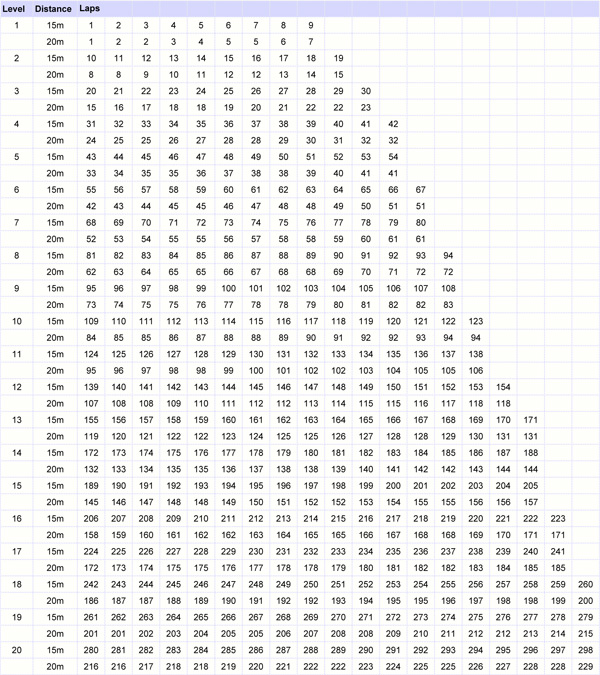
Below is the original FitnessGram conversion chart image for reference. This calculator digitizes this data for instant, accurate conversions:
References
- Leger, L.A., & Lambert, J. (1982). "A maximal multistage 20-m shuttle run test to predict VO2max." European Journal of Applied Physiology.
- Plowman, S.A., & Meredith, M.D. (2013). "FitnessGram/ActivityGram Reference Guide (4th Edition)." The Cooper Institute.
- Wood, R.J. (2025). "Aerobic Fitness Testing in Youth Athletes." TopEndSports Research.
- Mahar, M.T., et al. (2011). "Estimation of aerobic fitness from PACER performance." Preventive Medicine.
- Castro-Piñero, J., et al. (2010). "Criterion-related validity of field-based fitness tests in youth." Sports Medicine.
- Tomkinson, G.R., & Olds, T.S. (2008). "Field tests of fitness." Pediatric Exercise Science.
- Ruiz, J.R., et al. (2009). "Cardiorespiratory fitness and ideal cardiovascular health in adolescents." Heart.
- Silva, G., et al. (2013). "Calculation and validation of PACER test models in children." Journal of Science and Medicine in Sport.
- Mayorga-Vega, D., et al. (2015). "Criterion-related validity of the 20-m shuttle run test." Journal of Sports Science & Medicine.
- Burns, R.D., et al. (2015). "Cross-validation of aerobic capacity prediction models in adolescents." Pediatric Exercise Science.
Related Pages
PACER Test Instructions
Complete guide to administering the PACER test with audio resources
Learn More →Related Products
- Buy the Fitnessgram/Activitygram Test Administration Manual which includes a DVD with video clips and the PACER test cd.
 Any comments, suggestions, or corrections? Please let us know.