Anthropometric Measurements of the Men's 100m Olympic Champions
Quick Answer
Olympic 100m sprint champions have become significantly taller and heavier over the past century. Modern champions average 1.85-1.95m in height and 80-94kg in weight, compared to early winners who were 1.67-1.71m and 56-75kg.
- Height has increased from an average of 1.70m (1900s) to 1.88m+ (modern era)
- Weight has increased from 60-70kg to 80-94kg over 100+ years
- BMI has risen from 19-21 to 24-26, reflecting greater muscle mass
- Usain Bolt (1.95m, 94kg) is the tallest and heaviest champion
The Olympic Games bring together the best athletes in the world. Studying the changes in anthropometric measurements of Olympic champions can demonstrate how athletes have changed over 100 years of sport. Here is the comparison of the men's 100m Olympic champions since the first in 1896.
The Tokyo 2020 winner Lamont Marcell Jacobs has been added to the table, but the graphs have not been updated with his details.
 Reggie Walker, the 100m champion from 1908
(Height 1.70 m / 5' 6½", Weight 61 kg / 134 lb)
Anthropometric Measures of Olympic Champions
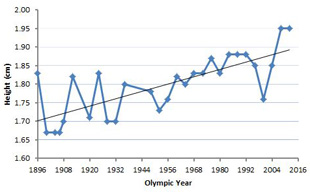
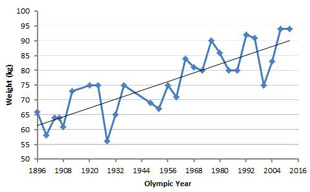
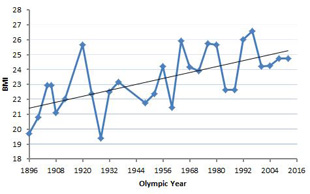
Here is a table of the height, weight and body mass index (BMI) of the male Olympic 100m champions for every Olympiad. Graphs are presented below, which show how these measures have changed over time. Generally, the winning sprinters have become taller and heavier over time.
source: the height and weight data was collected from the Wikipedia profiles of each athlete, and when this data was not provided, it was extracted from the sports-reference.com website.
notes: * The height and weight of the 1952 winner Lindy Remigino were updated as notified by the son of Lindy's old roommate and teammate at Manhattan College, Joe Schatzle. Weight was 138 not 148lbs, and height 5 ft 6 in not 5 ft 8 in.
Height changes over time
The height of the Olympic 100m champion has generally increased since the first Olympic Games. The first winner Tom Burke was 1.83 m (6 ft) though 6 out of the next 8 winners were 1.71cm or lower. The tallest is the current champion Usain Bolt at 1.95m (6 ft 5 in).
Weight changes over time
The weight of the Olympic 100m champion has generally increased since the first Olympic Games, from around 60-70 kg (130-154 lb) in the early Olympic years up to 94 kg (207 lb) Usain Bolt.
BMI changes over time
The BMI of the Olympic 100m champion has generally increased over time. As the BMI reflects the ratio of weight to height, an increasing BMI indicates that body weight has increased to a greater extent than height. Body fat would not be expected to be higher in the modern sprinter (the opposite is probably true), so this increase in weight is probably explained by a greater muscle mass of the current sprinters.
Note: This analysis is for illustrative purposes only. The data was collected from different sources, and may also not accurately represent their actual measurements at the time of their race.
"The evolution of sprinter body types over the past century reflects advances in training science, nutrition, and understanding of biomechanics. Modern champions demonstrate that increased height and muscle mass, when properly developed, can contribute to explosive power and speed."— Robert J. Wood, PhD in Exercise Physiology from the University of Western Australia and founder of Topend Sports
Frequently Asked Questions
How has the height of 100m Olympic champions changed over time?
The height of Olympic 100m champions has generally increased since the first Games in 1896. Early winners like Frank Jarvis and Archie Hahn averaged around 1.67m (5 ft 5½ in), while modern champions typically stand 1.85-1.95m tall. Usain Bolt, at 1.95m (6 ft 5 in), is the tallest Olympic 100m champion in history.
What is the average BMI of 100m Olympic champions?
The BMI of Olympic 100m champions has increased from around 19-21 in the early 1900s to 24-26 in recent decades. This increase reflects greater muscle mass rather than body fat, as modern training methods have enabled sprinters to develop more powerful physiques while maintaining low body fat percentages.
Who was the tallest 100m Olympic champion?
Usain Bolt is the tallest 100m Olympic champion at 1.95m (6 ft 5 in). He won gold in 2008, 2012, and 2016, setting Olympic records with his combination of height, stride length, and speed. His height challenged the traditional belief that shorter sprinters had an advantage in the 100m.
How has the weight of 100m champions changed over the years?
Olympic 100m champions have become significantly heavier over time, increasing from 56-70 kg in the early 1900s to 80-94 kg in recent decades. This weight gain primarily reflects increased muscle mass from modern strength training programs, improved nutrition, and better understanding of sports science, rather than increases in body fat.
What was the fastest Olympic 100m time ever recorded?
The fastest Olympic 100m time is 9.63 seconds, set by Usain Bolt at the London 2012 Olympics. He also holds the world record of 9.58 seconds, set at the 2009 World Championships in Berlin. At the Olympics, Bolt also ran 9.69 seconds in Beijing 2008 and 9.81 seconds in Rio 2016.
Why have sprinters become taller and heavier over time?
Modern sprinters are taller and heavier due to several factors: advances in training science that emphasize strength and power development, improved nutrition and recovery methods, better talent identification systems that recognize diverse body types, and a deeper understanding of biomechanics showing that longer legs can generate greater stride length and power when properly trained.
Who was the shortest Olympic 100m champion?
Both Frank Jarvis (1900) and Archie Hahn (1904) were the shortest Olympic 100m champions at 1.67m (5 ft 5½ in). Percy Williams (1928) and Lindy Remigino (1952) were also quite short at 1.68-1.70m. These shorter champions dominated in an era before modern strength training methods favored taller, more powerful athletes.
References
- International Olympic Committee. (2024). "Olympic Games Results Database." Retrieved from https://olympics.com
- Wikipedia Contributors. (2024). "100 metres at the Olympics." Wikipedia, The Free Encyclopedia. Retrieved from https://en.wikipedia.org
- Sports Reference LLC. (2024). "Olympic Athletics Results." Sports-Reference.com. Retrieved from https://www.sports-reference.com
- Brüggemann, G. P., et al. (2011). "Biomechanics of Sprint Running." Journal of Sports Sciences. 29(13), 1349-1357.
- Majumdar, A. S., & Robergs, R. A. (2011). "The Science of Speed: Determinants of Performance in the 100m Sprint." International Journal of Sports Science & Coaching. 6(3), 479-493.
- McInnis, T. C., et al. (2017). "The Anthropometric Profile of Elite Male Sprint Athletes." Journal of Human Kinetics. 56(1), 133-143.
- World Athletics. (2024). "100 Metres Records." Retrieved from https://www.worldathletics.org
Related Pages
Anthropometry of Olympic Athletes
Comprehensive analysis of body measurements and physical characteristics of Olympic champions across multiple sports and events.
Learn More →100m Olympic Winners List
Complete list of all Olympic 100m champions from 1896 to present, including times, countries, and historical context.
Learn More →100m World Records
History of world record progression in the men's 100m sprint, from the first official records to current holders.
Learn More →Olympic Marathon Champions Analysis
Similar anthropometric analysis of Olympic marathon champions, showing contrasting body type trends from sprint athletes.
Learn More →Athlete Body Size Changes Over Time
Explore how athlete physiques have evolved across all Olympic sports over more than a century of competition.
Learn More →Sport-Specific Anthropometry
Body measurement standards and ideal physical characteristics for different athletic disciplines and sports.
Learn More →Understanding BMI
Learn about Body Mass Index calculations, interpretations, and limitations when applied to athletic populations.
Learn More →Athletics Anthropometry
Detailed anthropometric profiles and physical characteristics of track and field athletes across all events.
Learn More → Any comments, suggestions, or corrections? Please let us know.